California Electric Bills Have Jumped 68% in Recent Years — Solar Plus Battery Storage Is How Some Homeowners Are Pushing Back
California Electric Bills Have Jumped 68% in Recent Years — Solar Plus Battery Storage Is How Some Homeowners Are Pushing Back
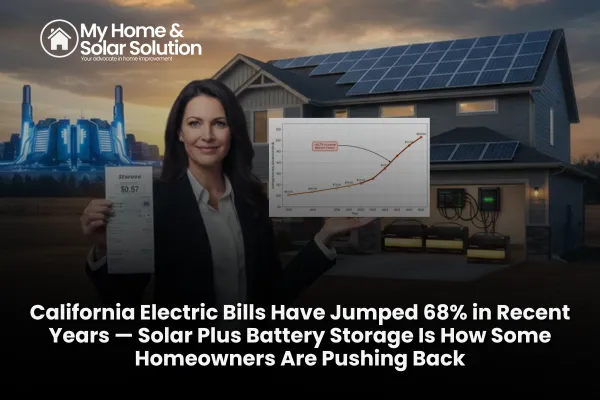
The number that stops people mid-sentence when they hear it: California residential electricity rates have increased approximately 68% over the past several years. A kilowatt-hour that cost $0.18 in the mid-2010s costs over $0.30 — and in some utility territories and usage tiers, over $0.50 — today. That increase isn't random noise. It reflects a combination of structural forces — wildfire mitigation, aging infrastructure, renewable integration costs, and surging demand from electrification — that show no sign of reversing. The rate trajectory projected by California's major utilities through 2026 and 2027 continues upward. For the average Southern California household paying $250–350/month for electricity, that 68% increase has already added $90–130/month to the household budget compared to a decade ago. Over the next decade, without intervention, further increases are nearly certain.
Some California homeowners are pushing back. Here's how, and why it works.
Where the 68% Increase Came From
The cumulative rate increase over the past decade reflects several compounding factors:
Wildfire mitigation: California's investor-owned utilities have spent billions on grid hardening, covered conductors, fault circuit interrupters, and undergrounding projects — all of which are capitalized and recovered through rates. The Thomas Fire, the Camp Fire, and subsequent wildfire events created enormous liability exposure that pushed utilities to accelerate these investments faster than originally planned.
Insurance costs: Utility insurance premiums surged after the wildfire liability settlements. Those costs are partially recoverable through rates.
Infrastructure replacement: Much of California's distribution infrastructure was built in the 1950s–1970s and is past its designed service life. Replacement costs are significant and ongoing.
Renewable portfolio compliance: California's renewable energy mandates require utilities to procure clean generation, some of which — particularly offshore wind and certain storage resources — is more expensive than legacy fossil fuel contracts.
Fixed charge introduction: The recent introduction of income-graduated fixed monthly charges adds a new baseline cost for all ratepayers that doesn't appear in older rate comparisons.
AI and EV load growth: Increasing demand from data centers and electric vehicles is adding procurement costs and infrastructure requirements.
Each of these factors is, in isolation, defensible. Together, they've produced a rate environment that is genuinely difficult for many California households.
The 68% in Your Bills' Specific Context
For individual households, the 68% average increase masks significant variation. Homeowners in higher usage tiers — households using more than 130% of baseline electricity allocation — have seen even steeper effective rate increases because tiered rate structures penalize higher usage more severely. Large homes, homes with electric vehicles, and homes in hotter climates (like the Ventura County inland areas) have often experienced increases well above the 68% average. At the same time, households that have reduced consumption through efficiency improvements, added solar, or shifted to time-of-use rates strategically have partially or fully offset these increases.
How Solar Plus Battery Storage Pushes Back
Going solar with battery storage is the most direct and effective tool available to California homeowners for pushing back against utility rate increases. Here's the mechanism: Wholesale energy at retail displacement: Your solar panels generate electricity at the amortized cost of the equipment — effectively zero per kWh once the system is paid off, or very low per kWh under a TPO program. You use that electricity instead of buying it from SCE at $0.30–$0.65/kWh. The difference is your savings.
Peak displacement: Your battery, charged by solar, supplies your home during the 4–9 PM peak window when SCE's rates are highest. You're not paying $0.55/kWh for evening electricity — you're using energy that cost you nothing to generate and store.
Rate increase insulation: A TPO program's monthly fee is fixed (or mildly escalating) regardless of what SCE does to its rates. If SCE raises rates another 30% over the next five years, your effective energy cost doesn't move proportionately — because 60–80% of your energy is coming from your fixed-fee solar program, not the utility.
This insulation from rate increases is often underappreciated relative to the raw monthly savings calculation. The value of solar doesn't just stay constant over time — it grows with every utility rate increase.
The Math Over Time
Consider a homeowner currently paying $300/month to SCE. Under a TPO solar-plus-battery program, that bill drops to $150/month total (TPO fee plus residual grid purchases).
Year 1 savings: $150/month, $1,800/year.
If SCE raises rates 5% annually (a reasonable projection given recent history), by year 5 the non-solar homeowner is paying $383/month. The solar homeowner is paying $160/month (with a modest escalator on the TPO fee). Year 5 savings: $223/month, $2,676/year.
By year 10: non-solar homeowner at $489/month, solar homeowner at $175/month. Savings: $314/month, $3,768/year. 10-year cumulative savings: approximately $25,000–$30,000, growing each year as the gap between utility rates and the fixed TPO fee widens.
This is why the 68% past increase matters: it demonstrates that the utility's trajectory is real, sustained, and structural. Projecting it forward for 10 years and then evaluating what solar savings would look like in that projected environment produces a compelling case for acting now.
What Qualifying Homeowners Can Do
My Home & Solar Solutions works with Ventura County homeowners and surrounding Southern California communities to access solar-plus-battery programs that immediately reduce monthly bills and provide long-term insulation from utility rate increases.
For qualifying homeowners, TPO programs with no upfront cost are available. The rate increases that have already happened will continue to happen. The question is whether your home is going to absorb them or hedge against them.
Visit https://myhomesolution.org/2026-california-utility-bill-changes to learn more about the 2026 rate changes and what you can do to protect your household budget. The 68% is already happened. Don't let the next 68% happen to you too.

