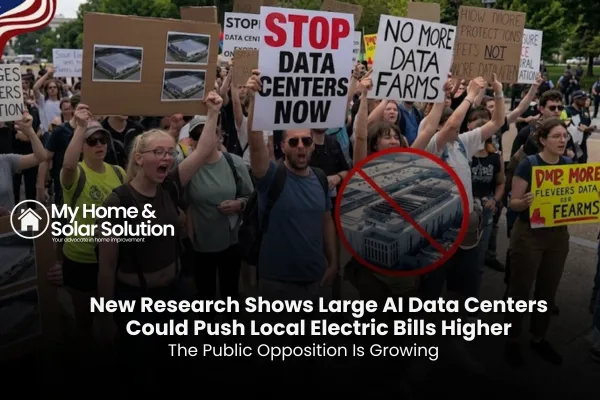
New Research Shows Large AI Data Centers Could Push Local Electric Bills Higher — and Public Opposition Is Growing
New Research Shows Large AI Data Centers Could Push Local Electric Bills Higher Public Opposition Is Growing
A growing body of research is drawing a direct line between AI data center development and higher residential electricity bills in the communities that host them. The findings are beginning to reach beyond academic and policy circles into mainstream media coverage — and they're fueling a wave of public opposition to data center siting decisions that, until recently, were largely rubber-stamped by local planning bodies. For California homeowners, this research adds quantitative grounding to something many have experienced qualitatively: utility bills that keep rising in communities with growing data center footprints, without adequate explanation of who's driving the increase or who's bearing the cost.
What the Research Is Finding
Academic researchers studying the relationship between large industrial electricity loads and residential rates have documented several mechanisms by which data center development can increase bills for nearby residents:
Infrastructure cost socialization: Studies of utility rate cases in data center-dense markets have found that residential customers are bearing a measurable share of the infrastructure costs created by large new data center interconnections. The magnitude varies by market and regulatory structure, but in some cases researchers have estimated residential rate impacts of several dollars per month per household in areas with heavy data center concentration.
Peak demand amplification: AI data centers, which operate at full load continuously, contribute to peak demand during the same high-stress periods when California residential rates are highest. Research on demand patterns has found that data center load growth is particularly concentrated in hours and seasons when grid costs are already elevated — amplifying rather than spreading peak cost pressures.
Generation procurement cost increases: Studies of wholesale electricity markets in data center-dense regions have documented upward pressure on power prices during high-demand periods, as large continuous loads compete with other users for available generation capacity. Higher wholesale prices translate into higher utility procurement costs and ultimately higher residential rates. Transmission congestion: Research on grid congestion patterns has found that concentrated large loads — like data center clusters — can create localized transmission constraints that increase grid operational costs in affected regions. The cumulative picture from this research: large AI data center development in residential utility service territories creates real, measurable rate impacts on residential customers — impacts that are currently difficult to quantify precisely because mandatory reporting and cost attribution don't exist, but that appear in aggregate rate data nonetheless.
The Public Opposition That's Following
Research findings typically take years to translate into public policy. But the public opposition to data center development in California communities is moving faster than the research can document, driven by lived experience more than academic papers.
Planning commission hearings on data center proposals in several California communities have drawn dozens or hundreds of public commenters in recent months — a turnout that would have been unusual even three years ago. The concerns raised span a consistent set of themes:
Water use and local supply impact. Power demand and rate impacts. Heat and noise from cooling systems. Land use conflicts with residential and agricultural uses. Inadequate community benefit sharing from facilities that impose local costs. Some communities have successfully required enhanced conditions on data center approvals — water use disclosures, energy efficiency minimums, contributions to local infrastructure funds. Others have denied permits outright. The legal landscape around data center regulation at the local level is developing rapidly.
What's Driving the Shift in Public Awareness
Several factors have accelerated public awareness of data center impacts over the past 18–24 months:
Mainstream media coverage: The New York Times, Washington Post, Bloomberg, and other major outlets have published detailed investigative pieces on data center water use, energy consumption, and community impacts. This coverage has reached audiences well beyond the utility regulation community. Viral social media content: Videos and posts documenting the physical scale of data centers — their size, their cooling tower noise, their utility infrastructure requirements — have spread widely in communities where facilities are being proposed. AI tool proliferation: As AI tools like ChatGPT, Claude, and others have become mainstream consumer products, public understanding that "using AI requires electricity and water" has grown. The connection between the AI tools people use and the infrastructure required to run them is more visceral than it was when AI was primarily a B2B technology. Rate increase coincidence: In communities where data center development coincided with utility rate increases, residents have drawn — sometimes accurately, sometimes oversimplistically — direct connections between the two.
The California Policy Response
California legislators have introduced bills addressing data center transparency and cost allocation, though most have not yet passed as of mid-2026. The regulatory proceedings at the CPUC addressing large load cost allocation are ongoing, with significant stakeholder activity from consumer groups, utilities, and technology industry representatives. The policy response will be meaningful eventually. But for homeowners concerned about the near-term rate impacts of data center development in their communities, regulatory relief is measured in years.
The Immediate Response: Energy Independence
My Home & Solar Solutions has one message for California homeowners watching this story unfold: you can't control where data centers are built or how the CPUC allocates their infrastructure costs. But you can reduce how much of your monthly budget is exposed to utility rates shaped by those decisions. A solar-plus-battery system reduces your grid consumption by 60–80%. Every percentage point of reduced grid consumption is a percentage point of insulation from whatever the utility rate environment throws at you — including rate impacts from data center development you never asked to host.
For qualifying Ventura County and Southern California homeowners, TPO programs with no upfront cost are available now. Visit https://myhomesolution.org/2026-california-utility-bill-changes to find out if your home qualifies.
The research is clear. The opposition is growing. The practical response is available today.

