AI Data Centers Are Driving a Power Demand Surge Utilities Must Solve — and Homeowners Are Being Asked to Help Fund It
AI Data Centers Are Driving a Power Demand Surge Utilities Must Solve — and Homeowners Are Being Asked to Help Fund It
California's electricity infrastructure was built to serve a specific load profile: residential homes that use power in the morning and evening, commercial buildings that peak during business hours, industrial facilities with predictable demand, and a relatively small number of large customers whose consumption was factored into long-range planning.
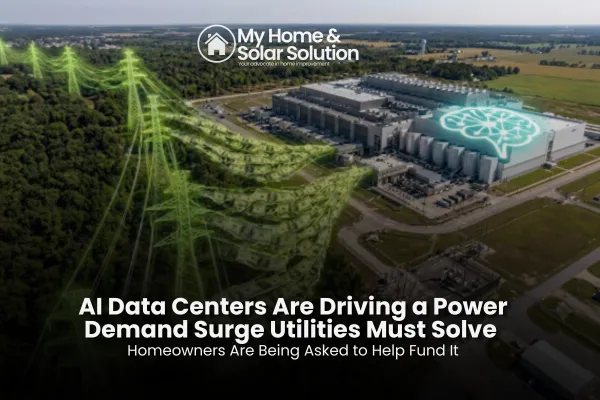
That planning model is being disrupted by artificial intelligence. AI data centers — which operate 24/7 at very high power density — are appearing in California's grid in volumes and at speeds that utility planners didn't anticipate. The surge is real, it's ongoing, and it's requiring expensive infrastructure responses.
The problem: most of those infrastructure costs are being paid by California residential ratepayers. Homeowners who have never used an AI tool and have no relationship with the companies building these facilities are nonetheless funding the grid upgrades required to serve them. Understanding this dynamic is important for any California homeowner making decisions about their own energy costs.
The Mechanics of How Data Center Load Growth Becomes Your Bill
When a large AI data center connects to the California grid, it triggers a series of infrastructure responses that ultimately flow into utility rates:
Interconnection infrastructure: The data center needs a high-capacity connection to the transmission or distribution grid. Building that connection — substations, transformers, switching equipment, transmission line extensions — requires capital investment by the utility. That capital enters SCE's rate base and is recovered through rates paid by all customers over 30–50 years.
Transmission upgrades: Large new loads often require upgrades to the broader transmission system to avoid congestion and ensure reliable delivery. These upgrades also flow into the rate base.
Generation procurement: The utility must secure additional generation capacity to serve new load. If the data center demand arrives faster than new renewable capacity can be built, the utility may need to procure more expensive power — including natural gas peaking capacity — to ensure reliability. Those procurement costs flow into rates.
Demand response program expansion: Utilities experiencing load growth from data centers often expand demand response programs — which pay customers to reduce consumption during peak periods — as a way to manage peak demand cost-effectively. These programs are funded through rates.
Each of these mechanisms has the same outcome: the costs of serving new large industrial load are shared across the entire ratepayer base rather than allocated specifically to the load that created them.
Why Cost Allocation Is a Policy Problem
The current regulatory framework in California socializes much of the infrastructure cost of new large load connections across the residential rate base. This allocation reflects how utility regulation has historically worked: all customers share the cost of the grid because all customers benefit from a reliable, interconnected system. The argument made by consumer advocates is that this framework was designed for a world where large new loads were relatively infrequent and small relative to the overall system — not for a world where dozens of AI data centers are connecting simultaneously, each requiring significant infrastructure investment. When a single data center requires a new $50 million substation, and that cost is socialized across SCE's 15 million customers, each customer pays a fraction of a cent per month. When dozens of data centers require similar upgrades simultaneously, the cumulative impact on residential rates is non-trivial.
CPUC proceedings on large load cost allocation are ongoing, and the direction of policy is uncertain. Consumer advocates argue for "cost causer pays" principles — requiring large new loads to bear more of the infrastructure costs they create. Utilities and data center operators argue that the current framework appropriately distributes costs across a system that benefits all users.
The Speed Problem
The surge in data center demand is creating a specific problem for grid planners: the facilities are connecting faster than infrastructure planning cycles anticipated. California utilities file general rate cases every three to four years. Between rate cases, the utility manages its capital spending against approved projections. When actual load growth significantly exceeds projections — as is happening with AI data center development — utilities face a mismatch between their capital spending authority and their actual infrastructure needs. Some utilities are filing emergency rate case requests or seeking CPUC approval for out-of-cycle infrastructure spending to address unexpected data center load growth. These requests, when approved, produce rate impacts between formal rate case cycles — adding to the cumulative rate pressure California homeowners experience.
What Homeowners Can Do
The regulatory response to data center-driven rate impacts will play out over years. Meaningful cost allocation reform — if it comes — will require CPUC proceedings, legislative action, and utility cooperation. The timeline is measured in years, not months.
For individual homeowners, the immediate and available response is to reduce their exposure to the utility rates that are being shaped by these dynamics. A solar-plus-battery system doesn't change what data centers pay for grid infrastructure — but it dramatically reduces how much grid power the homeowner purchases at rates that include those infrastructure costs. The financial case is straightforward: every kilowatt-hour your panels generate and your battery stores is a kilowatt-hour you don't buy from SCE at a rate that includes data center infrastructure cost recovery. Over a 25-year system life, as those infrastructure costs continue to accumulate and flow through rates, the insulation from grid pricing that solar-plus-battery provides becomes increasingly valuable.
My Home & Solar Solutions helps qualifying California homeowners access solar and battery programs that provide immediate and long-term relief from utility rates shaped by infrastructure dynamics outside your control. For qualifying Ventura County homeowners, TPO programs with no upfront cost are available.
Visit https://myhomesolution.org/2026-california-utility-bill-changes to learn more about the 2026 rate environment and what California homeowners can do now. The data centers are here. The costs are landing. Your response is available today.

