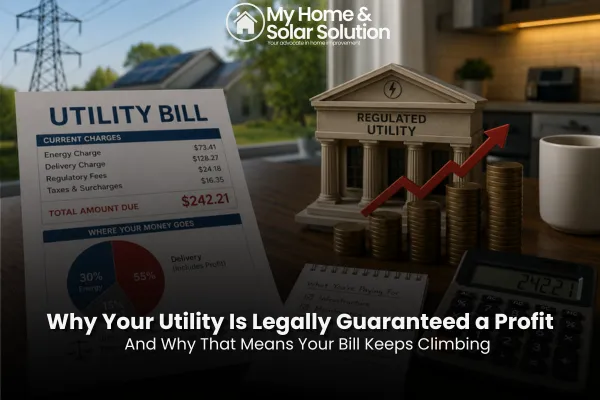
Why Your Utility Is Legally Guaranteed a Profit — And Why That Means Your Bill Keeps Climbing
Why Your Utility Is Legally Guaranteed a Profit — And Why That Means Your Bill Keeps Climbing
Many homeowners assume that utility rate increases happen because costs went up — fuel got more expensive, a storm caused damage, equipment needed repair. That's part of the story, but it misses a more fundamental feature of how California's investor-owned utilities are regulated: they're not just allowed to recover their costs. They're legally entitled to earn a guaranteed profit on top of them.
How Cost-of-Service Regulation Works
California utilities like SCE, SDG&E, and PG&E operate under a framework called cost-of-service regulation. Regulators — primarily the California Public Utilities Commission — review and approve a utility's planned capital investments: new transmission lines, substations, wildfire mitigation equipment, grid modernization projects, and more. Once approved, that investment becomes part of the utility's "rate base," and the utility is entitled to earn a set rate of return on that rate base, typically in the range of 9-10%, recovered from customers through their monthly bills. This is fundamentally different from how most regulated or competitive businesses operate. A retailer that builds an expensive new store has to hope sales justify the cost. A utility that gets a new substation approved doesn't have to hope — regulators have already guaranteed it a specific financial return on that investment, funded directly by ratepayers.
Why This Creates an Incentive to Build
This regulatory structure creates what economists call the "Averch-Johnson effect" — a documented tendency for regulated utilities to over-invest in capital projects, because more approved capital investment directly increases the size of the rate base, which directly increases the utility's guaranteed earnings. It's not that utilities are doing anything illegal or even necessarily wrong — they're responding rationally to the incentives regulators have built into the system.
Curious whether you qualify for California's Net-Billing rate plan? Check your eligibility and current CPUC rates at myhomesolution.org/california_public_utility_commissions.
For homeowners, the practical effect is that legitimate, necessary infrastructure spending — wildfire hardening after years of devastating fires, grid upgrades to handle EV charging and AI data center demand — gets bundled together with a guaranteed profit margin for the utility, all flowing into the rate you pay every month.
What This Means for Your Bill
This explains why rate increases feel relentless and rarely temporary. As long as the utility continues to get capital investments approved by regulators — and there's no shortage of legitimate infrastructure need in California right now — the rate base keeps growing, and the utility's guaranteed return keeps growing with it. There's no mechanism in this model that naturally pushes rates back down once costs are "caught up."
What Homeowners Can Do
Since utility profit is structurally tied to how much approved infrastructure exists, the most direct lever an individual homeowner has isn't a regulatory one — it's reducing how much of that regulated, profit-bearing electricity you need to buy. Solar and battery storage let you generate and store power outside this system entirely, insulating a meaningful portion of your energy costs from a rate structure that's mathematically designed to grow.
Lower Electric Bill By 50% Without leasing, financing or paying cash for solar
California utilities aren't just recovering costs — they're earning a regulator-guaranteed profit on every dollar of approved infrastructure investment. That structural reality, more than any single cost driver, explains why rate increases keep coming and why generating your own electricity is one of the few ways to meaningfully limit your exposure to it.
Curious whether you qualify for California's Net-Billing rate plan? Check your eligibility and current CPUC rates at myhomesolution.org/california_public_utility_commissions.

