Time-of-Use Rates 101: Why When You Use Power Matters as Much as How Much
Time-of-Use Rates 101: Why When You Use Power Matters as Much as How Much
Most homeowners think about their electricity bill in terms of total usage: how many kilowatt-hours the household consumed in a month. Under time-of-use rate plans, which most California utilities now use as the default residential structure, that's only half the picture. The other half is timing — the exact hours during which that electricity was used — and it can matter just as much as the total amount.
How time-of-use pricing actually works
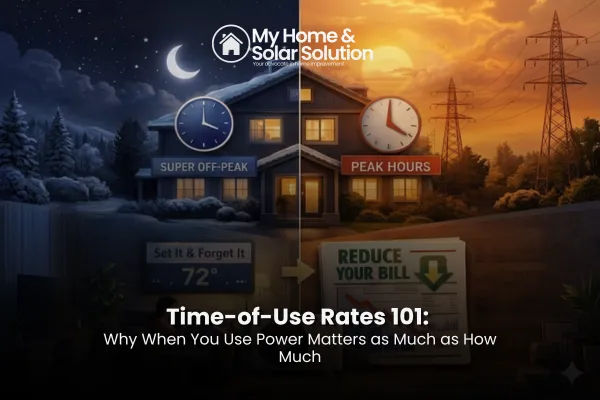
Time-of-use rates divide the day into pricing periods, typically with a peak window in the late afternoon and evening, often 4pm to 9pm, when electricity costs the most, and off-peak periods overnight and midday when it's cheaper. The same kilowatt-hour of electricity can cost two, three, or more times as much during peak hours compared to off-peak hours, depending on the utility and rate plan.
Why this catches a lot of homeowners off guard
A household that runs the dishwasher, does laundry, cooks dinner, and cools the house down in the early evening — completely normal daily patterns — is doing almost all of that during the most expensive pricing window of the day. Two households with identical total monthly usage can end up with meaningfully different bills if one concentrates its usage during peak hours and the other spreads it out or shifts it to off-peak windows.
Lower your monthly electric bill by 50% without need to lease, finance or pay cash for solar + battery equipment
What this means for solar-owning households specifically
For a homeowner with rooftop solar, time-of-use pricing changes the value proposition in an important way: solar panels generate the most power during midday hours, which are typically off-peak and lower-value under time-of-use plans, while the household's actual peak usage happens in the evening, after solar production has already dropped off. Without a battery, that mismatch means a lot of a solar system's most valuable output goes unused by the household in the exact hours it would matter most.
Lower your monthly electric bill by 50% without need to lease, finance or pay cash for solar + battery equipment
Where battery storage fits in
A home battery closes that timing gap directly, storing midday solar production and releasing it during the expensive evening peak window. That shift — using stored solar during peak hours instead of buying grid power — is where the majority of a time-of-use rate plan's savings potential actually lives for a solar-equipped home.
Lower your monthly electric bill by 50% without need to lease, finance or pay cash for solar + battery equipment
If you want to understand how time-of-use rates are affecting your bill and whether battery storage would help you capture more value from your solar production, My Home & Solar Solutions can walk you through it. Visit myhomesolution.org to learn more.

