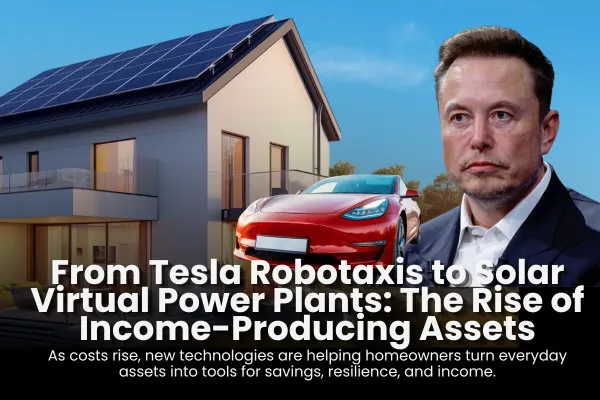
From Tesla Robotaxis to Solar Virtual Power Plants: The Rise of Income-Producing Assets
From Tesla Robotaxis to Solar Virtual Power Plants: The Rise of Income-Producing Assets
As costs rise, new technologies are helping homeowners turn everyday assets into tools for savings, resilience, and income.
For decades, most household purchases followed the same financial pattern: cars depreciated, utility bills increased, and homes consumed energy rather than producing value.
That model may be beginning to change.
In recent months, Elon Musk has renewed discussion around Tesla’s long-promised Robotaxi network — a system where Tesla owners could potentially add their vehicles to a self-driving ride-sharing platform and earn revenue while the car is not in use. Under the proposed structure, Tesla would reportedly keep around 25% of ride revenue while vehicle owners receive the remaining 75%.[1]
Why Tesla Robotaxi?
The concept is simple but powerful: instead of a parked vehicle sitting idle in a driveway, it becomes part of a larger income-producing network.
At the same time, a parallel transformation is quietly happening in the energy industry through solar battery Virtual Power Plants, commonly called VPPs.
Virtual Power Plants Pay Homeowners For Their Solar & Battery Power
Virtual Power Plants connect thousands of residential batteries, electric vehicles, smart thermostats, and solar systems into coordinated energy networks that utilities can use during periods of high electricity demand. Rather than building expensive new power plants, utilities and grid operators can draw small amounts of stored energy from participating homes to stabilize the grid during heat waves, peak evening demand, or emergency events.[2]
In California, lawmakers are actively exploring ways to expand these programs. Senate Bill 913 would create new pathways for VPPs to compete with traditional fossil-fuel peaker plants and potentially increase compensation opportunities for homeowners with solar and battery systems.[2]
The shift reflects a larger economic trend:
Consumers are no longer just buying products. Increasingly, they are buying assets connected to networks.
A car connected to a Robotaxi platform.
A battery connected to a Virtual Power Plant.
A home connected to a decentralized energy marketplace.
The similarities between these systems are striking:
Robotaxis monetize parked vehicles.
VPPs monetize stored energy.
AI software optimizes both systems in real time.
Owners participate in larger infrastructure networks while keeping a portion of the value generated.
This evolution comes as Americans face rising costs across nearly every category of daily life — from insurance and utilities to fuel and housing. Some homeowners participating in VPP programs are already receiving compensation, bill credits, or seasonal payments for allowing utilities to access stored battery power during grid events.[3]
In one California demonstration, more than 100,000 residential batteries were coordinated together as a single distributed power resource, collectively delivering over 500 megawatts of electricity during peak evening demand.[3]
Energy analysts increasingly believe distributed battery networks could become critical infrastructure as electricity demand rises due to artificial intelligence, electrification, air conditioning demand, and electric vehicle adoption. Rather than relying entirely on centralized power plants, the future grid may depend heavily on neighborhoods filled with connected energy assets.[4]
Of course, both technologies still face challenges.
Tesla’s Robotaxi ambitions remain subject to regulatory approvals, safety validation, and broader deployment hurdles. Musk himself recently acknowledged the company is taking a more cautious rollout approach for autonomous vehicles.[5]
Similarly, Virtual Power Plants are still evolving, and homeowner compensation structures vary widely depending on the utility, battery provider, and local regulations. For qualifying homes, the utility provider will supply the homeowner with solar panels, Tesla Powerwalls, or other solar-powered batteries so they can generate and store energy for later use. All installation and maintenance costs are covered by the utility.
But the direction is becoming increasingly clear:
the modern economy is shifting toward connected assets that can produce value beyond their original purpose.
In the years ahead, some experts believe the most valuable homes may not simply be the largest homes or homes in the best zip codes — but homes equipped with batteries, solar generation, backup power, and participation in intelligent energy networks.
Just as the internet transformed spare bedrooms into Airbnb income streams and smartphones into mobile businesses, connected energy systems may transform garages, driveways, and rooftops into part of the next generation of infrastructure.
Sources
[1] MEXC — “Tesla Owners Could Join Robotaxi Network and Keep 75% of Revenue”
https://www.mexc.com/news/743991
[2] Canary Media — “California Looks to Expand Virtual Power Plants”
https://www.canarymedia.com/articles/virtual-power-plants/new-bill-vpp-california
[3] PV Magazine USA — “100,000 Residential Batteries Tested as One Distributed Power Plant”
https://pv-magazine-usa.com/2025/08/06/100000-residential-batteries-in-california-tested-as-one-distributed-power-plant
[4] Avanza Energy — “Virtual Power Plants Full Report”
https://avanzaenergy.substack.com/p/virtual-power-plants-full-report
[5] Reuters — “Musk Sounds Cautious Tone on Robotaxi Rollout”
https://www.reuters.com/business/autos-transportation/musk-sounds-cautious-tone-robotaxis-amid-slower-than-expected-rollout-2026-04-23/

