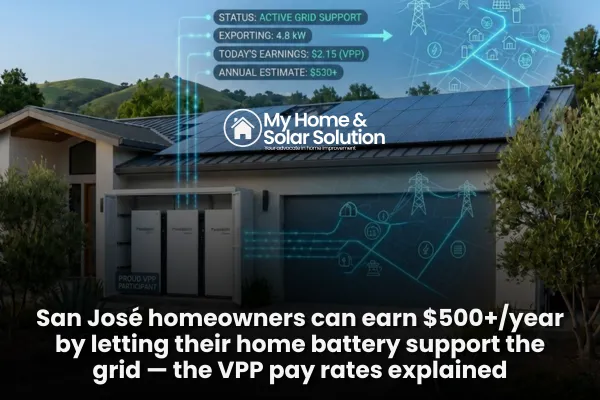
San José homeowners can earn $500+/year by letting their home battery support the grid — the VPP pay rates explained
SCE Summer Rates Hit Hardest Right When Your Air Conditioning Runs Hardest — Solar Batteries Can Change That
If you've ever opened your SCE bill in August and done a double-take at the number, you already understand intuitively what utility economists call the "summer peak problem." Southern California electricity rates are structured to charge the most during the hours when demand is highest — and in summer, those hours coincide almost exactly with when residential air conditioning runs at maximum intensity. The result: the same household that pays $180/month for electricity in February might pay $350–$450/month in July and August, not because they're doing anything differently, but because the utility charges more per kilowatt-hour during the hours when cooling is unavoidable.
Solar batteries directly address this mismatch. Here's why summer is where the savings are largest — and how a properly designed system changes the economics of Southern California summers.
Why Summer Bills Spike
SCE's time-of-use rate structure divides the day into pricing tiers. Under TOU-D-PRIME — the default rate for most new NEM 3.0 customers — peak rates apply from 4 PM to 9 PM daily, year-round. During this window, SCE charges its highest per-kWh rates, which have been in the range of $0.50–$0.65+/kWh for higher usage tiers.
In summer, the alignment between peak rate hours and peak cooling hours is nearly perfect: The sun is highest and hottest from noon to 3 PM, loading your home's thermal mass with heat.
That stored heat radiates into your living space in the late afternoon.
By 5–6 PM, your AC is working hardest to overcome both the residual heat load and the still-warm outdoor temperature. That peak cooling load runs precisely through the 4–9 PM peak rate window.
A central air conditioning system draws 2,500–5,000W while running. If your AC cycles 60–70% of the time during a hot August evening, your household is pulling 1,500–3,500W of AC-related load for five hours straight — all at peak rates. The math: 3 kW average AC load × 5 hours × $0.55/kWh = $8.25 per evening from AC alone. Over 30 summer evenings: $247.50 just for peak-hour air conditioning.
How a Solar Battery Addresses Summer Peak Costs
A properly sized solar-plus-battery system disrupts this pattern at its root. During the day, your solar panels generate peak power from 10 AM to 3 PM — when the sun is at its highest. Your home's AC load during this period is lighter (you're often not home, and the outdoor temperature hasn't peaked yet). The result: significant surplus solar generation flows into your battery. By 4 PM, when peak rates kick in, your battery is fully charged from free solar power. It begins supplying your evening loads — including your air conditioning — at zero cost. You buy nothing from SCE during the peak window. The battery powers your AC through 4, 5, 6, 7, 8, and 9 PM — the most expensive hours on the rate schedule — without drawing a single kilowatt-hour from the grid. After 9 PM, rates drop significantly, and any continued AC demand draws cheaper off-peak power.
Your $247.50/month in peak AC costs drops toward zero.
The Summer Sizing Question
Summer is when battery capacity matters most. In winter, your AC load is minimal, and a single battery handles evening loads easily. In summer, with AC cycling heavily through the 4–9 PM window, a single battery's 13.5 kWh may or may not get you through the full peak window depending on your home size and cooling load.
Key summer sizing considerations:
Home size and insulation: A well-insulated 1,500 sq ft home may draw 1.5–2 kW from AC cycling. A 3,000 sq ft home with older insulation may draw 3–4 kW. These numbers multiply quickly over five peak hours. Solar array size: A larger solar array charges the battery more completely before the peak window opens. A 12–14 kW array in summer typically generates enough to fully charge two Powerwalls and cover daytime loads simultaneously. Start-of-peak battery state: If your battery enters the 4 PM window at 80% charge due to afternoon cloud cover, you may have 10.8 kWh of stored energy for a 5-hour peak. At 2.5 kW average AC load, that's 4.3 hours — just short of full peak coverage. Two batteries extend this to 8+ hours.
The Summer Export Opportunity
Under NEM 3.0, there's an additional summer-specific benefit for households with robust solar production: certain grid stress events during California heat waves can temporarily elevate export credit rates significantly. The CAISO grid is most stressed on extreme summer afternoons, and the avoided cost of power during those events is much higher than average. A battery management system that monitors grid conditions and strategically exports during these high-value windows can generate additional bill credits on top of the self-consumption savings. This is an advanced optimization — it doesn't apply every day — but it represents additional value during the hottest, most grid-stressed periods of the year.
What This Means for Your Summer Bill
For a Ventura County homeowner on SCE paying $350–400/month in summer, a properly sized solar-plus-battery system targeting the peak window can realistically cut the summer bill to $60–100/month — a reduction of 70–80%.
Across a three-month summer, that's $750–1,050 in savings. Across 10 summers, $7,500–10,500 — and that's before accounting for SCE rate increases that will make the baseline comparison even more dramatic.
My Home & Solar Solutions specializes in systems optimized for Southern California's summer rate environment. We size solar and battery capacity specifically to address the peak cooling window — not to a generic standard that ignores California's most expensive hours.
Visit https://myhomesolution.org/southern-california-edison-net-billing to learn more about how SCE's rate structure affects summer bills and what a solar-battery system could do for your specific household. Summer is where the battle is won or lost. We make sure you win it.

