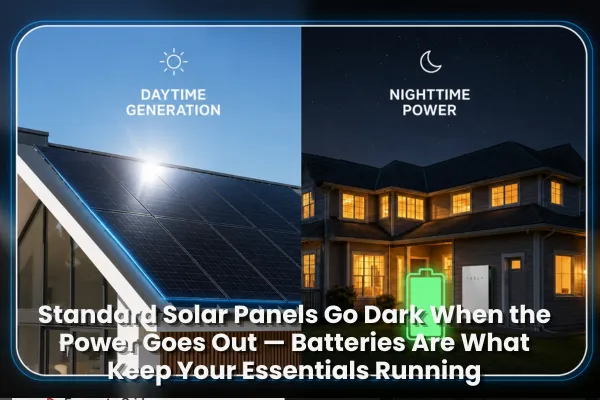
Standard Solar Panels Go Dark When the Power Goes Out — Batteries Are What Keep Your Essentials Running
Standard Solar Panels Go Dark When the Power Goes Out — Batteries Are What Keep Your Essentials Running
The salesperson mentioned it briefly. Maybe you caught it, maybe you didn't. But somewhere in the conversation about monthly savings and system payback, there's a fact that most solar companies don't lead with: your solar panels will shut off the instant the power goes out. Not malfunction. Not slow down. Shut off — completely, automatically, and by design. If you're counting on your solar panels to keep your refrigerator running during a wildfire-related PSPS event, or to keep your medical equipment on during a multi-day outage, that assumption is about to cost you in the worst possible way. Here's why this happens, and why a battery is the only thing that actually keeps your essentials running when the grid fails.
The Safety Mechanism You Didn't Know About
Every grid-tied solar inverter — the device that converts your panels' DC power into usable AC electricity — includes anti-islanding protection. This feature monitors the grid connection continuously. The moment it detects a grid outage, it shuts down your solar system in milliseconds. This is not optional. It's required by electrical code and utility interconnection rules. The reason: when utility linemen are working to restore power, they need to know the lines they're touching are de-energized. A solar system that continued feeding power into a downed grid could electrocute a worker trying to restore your neighborhood's service.
So your panels — regardless of how much sun is shining, regardless of how recently they were installed, regardless of how expensive they were — go completely dark when the grid does.
What This Means for PSPS Events
California's investor-owned utilities — SCE, PG&E, and SDG&E — conduct Public Safety Power Shutoffs (PSPS) when weather conditions create significant wildfire risk. High winds, low humidity, dry vegetation: the utilities proactively de-energize power lines before sparks can happen.
In Ventura County and surrounding Southern California communities, PSPS events are a documented, recurring reality. The 2019 shutoffs affected hundreds of thousands of customers. Subsequent events have continued on a smaller but still impactful scale. When your utility triggers a PSPS, your solar panels shut off. Your home is dark. If it's a summer event, your air conditioning stops. If you have a refrigerator full of food or medication that requires refrigeration, the clock starts ticking immediately. For a homeowner who went solar specifically because they thought it would protect them from outages, this is a painful discovery to make at 10 PM in August when it's 95 degrees inside and the neighborhood is silent.
What Batteries Actually Do
A home battery system equipped with backup functionality changes this picture entirely. When the grid goes down — whether due to a PSPS, equipment failure, wildfire, heat wave grid stress, or any other cause — a properly configured battery system automatically disconnects your home from the public grid. Within milliseconds, it creates what's called an "island": a self-contained electrical environment where your battery supplies power to your home. Within this island, your solar panels can safely continue to operate. They generate power, the battery stores and dispatches it, and your home runs normally. The utility grid being down is essentially invisible to your household.
What stays on depends on how your system is configured:
Critical loads configuration: A dedicated backup panel protects specific circuits — refrigerator, key lights, router, phone charging, and any medical equipment. Everything else powers down during the outage. This is the most common entry-level backup configuration.
Whole-home backup: With sufficient battery capacity, the entire home stays powered — lights, HVAC, appliances, and all. This typically requires two or more Powerwall units or equivalent capacity.
The essentials that matter most to your family — that's the conversation to have before you install anything.
How Long Does Battery Backup Actually Last?
The duration of backup power depends on three variables: battery capacity, your essential loads' power draw, and whether your solar panels are generating to replenish the battery.
A single Tesla Powerwall 3 (13.5 kWh usable) powering critical loads — refrigerator, lights, router, and phone charging — can typically sustain 12–24 hours without solar replenishment. With solar panels generating during daylight hours, a single battery can stretch a critical loads configuration through multiple days indefinitely.
For a whole-home setup during a heat wave — with air conditioning running — a single battery may last only 4–6 hours of normal use. Two or three batteries, replenished daily by solar, can sustain whole-home operation through multi-day events.
This is why system sizing matters, and why the backup conversation needs to happen before installation, not after.
The Essentials That Qualify for Backup Priority
Different households have different backup priorities. Common essential loads California homeowners prioritize:
Refrigerator and freezer: Food preservation is a universal priority. A typical refrigerator draws 100–150W continuously.
Medical equipment: CPAP machines (20–60W), home oxygen concentrators (200–600W), insulin refrigerators, and motorized mobility equipment.
Internet and communication: Router and modem (20–40W combined). In an emergency, staying connected to information is critical.
Lighting: LED lighting draws very little power — a whole-house LED setup might draw 200–400W total.
Cell phone and device charging: Minimal draw, enormous practical importance.
Air conditioning: Highest draw of common household equipment (2,000–5,000W for central AC). Requiring multiple batteries or strategic use to sustain through extended outages.
Getting the Right System
My Home & Solar Solutions specializes in solar-plus-battery configurations for Ventura County and Southern California homeowners. We conduct a load analysis before recommending any system, identifying your essential loads, calculating backup duration under different scenarios, and designing a configuration that actually protects what matters to your household.
For qualifying homeowners, we offer access to TPO programs that include battery backup with no upfront cost.
Visit https://myhomesolution.org/california_public_utility_commissions to learn more. Solar panels are a great investment. Batteries are what make them a resilience investment too.

