Solar Savings Start When Your Home Buys Less Power From the Grid — Here's How Batteries Stretch Those Savings Further
Solar Savings Start When Your Home Buys Less Power From the Grid — Here's How Batteries Stretch Those Savings Further
The core mechanic of residential solar is simple: every kilowatt-hour of electricity your panels generate and your home consumes is a kilowatt-hour you don't buy from the utility. At California's rates — some of the highest in the country — each avoided kilowatt-hour is worth $0.30 to $0.65 or more, depending on the time of day and your utility. That self-consumption is where solar savings begin. And a battery is the tool that makes those savings as large as they can possibly be.
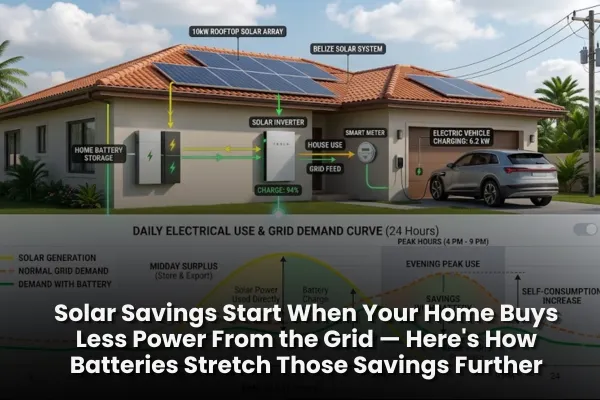
Here's a detailed look at how savings accumulate across a solar day — and how a battery dramatically amplifies every step of that process.
Step 1: Daytime Self-Consumption
-The moment your panels start generating — typically around 7–8 AM as the sun rises — they begin displacing grid power. Every watt your home consumes from solar rather than SCE is a watt you don't pay for.
During the morning, your home's loads are typically modest: refrigerator cycling, lights, small appliances. Solar covers all of these easily. You're generating more than you're consuming by mid-morning.
Savings at this stage: meaningful but moderate, because your consumption is low and the grid power you're displacing is off-peak (not the most expensive power of the day).
Step 2: Midday Surplus — The Battery Decision Point
-By 10–11 AM, your panels are generating at or near peak output. If you have a 10 kW system, you might be producing 8–9 kW while your home is consuming 2–3 kW. That 5–6 kW of surplus is the moment the battery decision matters.
Without a battery: The surplus flows to the grid. Under NEM 3.0, SCE credits you $0.02–$0.08/kWh for that export. You've given away your most valuable resource at a tiny fraction of retail rate.
With a battery: The surplus flows into your Powerwall, charging it at essentially zero cost. You're storing power that's worth $0.50+/kWh at peak rates and paying nothing for it.
Step 3: Afternoon Coverage
-From noon through late afternoon, your panels continue generating at high output. Your home's loads are covered: refrigerator, some appliances, possibly a home office. Your battery is approaching or at full charge. You haven't bought anything from the grid since morning.
Step 4: The Peak Window (4 PM–9 PM) — Where the Real Savings Live
-This is the moment the battery's value becomes most visible. Panel generation is declining. The sun is lower. Your household consumption is rising — people are home, cooking, running laundry, watching TV, running the AC against the day's heat. Under SCE's TOU-D-PRIME rate, electricity during this window costs $0.50–0.65/kWh. This is the most expensive power of the day — and it's exactly what the battery eliminates.
Without a battery: You buy 10–15 kWh from SCE during the peak window. At $0.55/kWh average, that's $5.50–8.25 per evening, or $165–247 per month just in peak-hour charges.
With a battery: Your Powerwall discharges. You buy nothing from SCE during the peak window. That $165–247/month goes back in your pocket.
Step 5: After 9 PM — Off-Peak Coverage
After the peak window closes, rates drop significantly. Any grid power you draw overnight is purchased at the cheapest rates of the day. If your battery isn't fully depleted, it may continue to supply your overnight loads. If it does run out, you're at least buying the cheapest power available rather than peak-rate power.
The Cumulative Savings Picture
Add up the steps: daytime self-consumption, battery storage of midday surplus, peak-window battery dispatch, and off-peak grid purchases when necessary. The result for a typical Southern California household on SCE with a 10 kW solar array and one or two Powerwalls:
-Monthly utility bill reduction: 60–80% for most households
-Annual savings: $1,500–$3,000+ depending on starting bill
-10-year savings: $15,000–$30,000+, growing with each utility rate increase
These numbers aren't hypothetical. They're the outcome of systems designed specifically for California's time-of-use rate environment — systems that treat each hour of the day as a separate economic opportunity and deploy solar energy at its maximum value.
How Battery Management Software Optimizes Every Step
Modern home batteries don't just charge and discharge. They run optimization algorithms that track your utility's time-of-use windows, your solar generation forecast, and your household's consumption patterns to decide in real time what to do with every kilowatt-hour.
Tesla Powerwall's Storm Watch feature, for example, automatically charges the battery to 100% when weather apps predict extreme weather — preemptively filling the tank before conditions worsen. Time-based control mode charges preferentially during off-peak windows and discharges during peak windows.
These software features are a significant part of what makes modern batteries so much more effective than earlier storage technologies at maximizing bill savings.
My Home & Solar Solutions designs solar-plus-battery systems for Ventura County and Southern California homeowners that are optimized specifically for the SCE and CPUC rate environment. We don't install generic packages — we design systems where every component and configuration decision is made with your bill in mind.
For qualifying homeowners, TPO programs with no upfront cost are available. The savings start from day one.
Visit https://myhomesolution.org/california_public_utility_commissions to schedule a free assessment and get a projection of what a solar-plus-battery system would actually save at your address.

