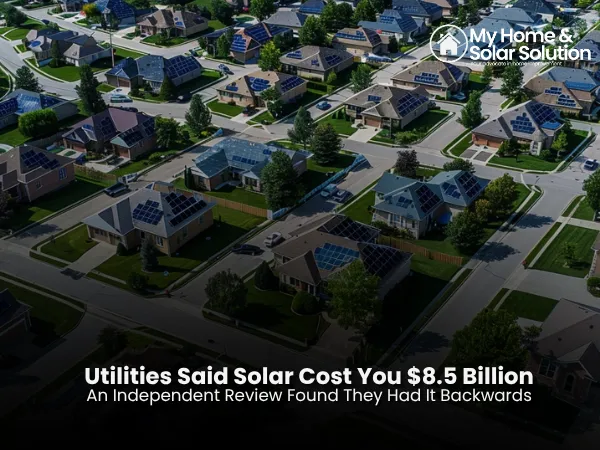
Utilities Said Solar Cost You $8.5 Billion. An Independent Review Found They Had It Backwards
Utilities Said Solar Cost You $8.5 Billion. An Independent Review Found They Had It Backwards
For years, California utilities and regulators have pointed to a specific villain when explaining the state's sky-high electricity rates: rooftop solar owners. The argument, often called the "cost shift," claims that homeowners with solar panels avoid paying their fair share of the grid, quietly shifting billions of dollars in costs onto everyone else's bill.
In August 2024, the California Public Utilities Commission's Public Advocates Office put a number on that claim: $8.5 billion a year, more than double what it had estimated just three years earlier. The figure spread quickly through news coverage and utility rate-case filings, becoming a talking point for reducing compensation to solar customers even further. There was just one problem. When an independent energy economist redid the analysis using the same underlying data, the number didn't just shrink — it flipped. Rather than costing other ratepayers $8.5 billion, rooftop solar customers appear to be saving them roughly $1.5 billion a year. That's a swing of about $10 billion between the official narrative and an independent recalculation.
Where the Cost-Shift Story Came From
The idea that rooftop solar threatens utility finances isn't new. It traces back to a 2013 report commissioned by the Edison Electric Institute, the trade association for investor-owned utilities, warning that distributed solar, energy efficiency, and flat demand growth could trigger a utility "death spiral." The report framed solar customers as a competitive threat rather than a grid resource — a framing utilities have leaned on ever since to justify higher fixed charges and lower compensation for solar exports. That strategy shows up directly in California's own net metering history. Under the original NEM 1.0 program, solar owners were credited close to the full retail rate for power they sent back to the grid. NEM 2.0 trimmed that credit. NEM 3.0, which took effect in April 2023, cut compensation by roughly 75%, down to around 8 cents per kilowatt-hour for certain times during the day and increasing compensation after the sun goes down — even as the retail rate utilities charge neighbors for that same electricity has stayed at 30 cents or more.
How the $10 Billion Gap Happened
Richard McCann, an energy economist at M.Cubed Consulting, went back through the Public Advocates Office's methodology line by line. He found several significant errors, the largest being that regulators counted electricity solar homeowners generate and use themselves — power that never touches the grid — as a "cost" to the utility. Homeowners don't pay utilities for electricity they produce and consume on their own roof, so counting it as lost utility revenue isn't a cost shift; it's a bookkeeping mistake, and it accounted for nearly $4 billion of the original estimate. The reanalysis also found that regulators left out more than a decade of benefits from distributed solar: avoided power plant construction, reduced strain on transmission lines, and lower wholesale energy costs. California's solar rooftops have offset roughly 23,000 gigawatt-hours of annual demand since 2006 — savings the original report simply didn't count. Several energy economists have since backed the corrected numbers publicly, and pointed to a different explanation for California's rates, which now run close to three times the national average: utility overhead, infrastructure spending, and executive compensation — not rooftop solar.
What This Means If You're Weighing Solar
If you've been holding off on solar because of headlines about rate hikes and "cost shifting," it's worth understanding what actually drives your utility bill. Independent analysis increasingly points to utility infrastructure spending and rate design — not your neighbor's rooftop panels — as the bigger factor behind rising costs.
California Electricity Rates Have Hit A Record High
That doesn't mean net metering compensation hasn't gotten less generous; NEM 3.0 is real, and it changes the math on how quickly solar pays for itself through exports alone. But it's also why pairing solar with a home battery has become the more common approach for California homeowners: instead of selling excess power back to the grid for a few cents a kilowatt-hour, a battery lets you store and use your own electricity in the evening, when utility rates are highest.
My Home & Solar Solution helps homeowners evaluate whether solar and battery storage make sense for their specific usage and rate plan — not based on outdated cost-shift talking points, but on the actual numbers for your home. Visit myhomesolution.org to see what a personalized analysis looks like.

