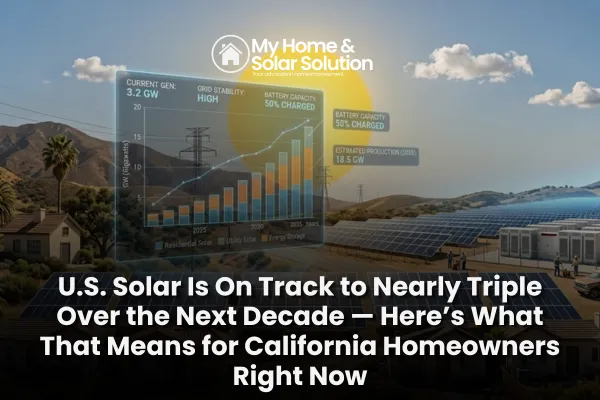
U.S. Solar Is On Track to Nearly Triple Over the Next Decade — Here’s What That Means for California Homeowners Right Now
U.S. Solar Is On Track to Nearly Triple Over the Next Decade — Here's What That Means for California Homeowners Right Now
The U.S. solar industry is on a trajectory that, a decade ago, would have seemed implausible: total installed solar capacity is projected to nearly triple by the mid-2030s, driven by declining panel costs, federal incentives under the Inflation Reduction Act, and surging electricity demand from electrification and AI infrastructure. For California homeowners, this macro trend has concrete implications — for the programs available today, for the value of going solar sooner rather than later, and for how the state's energy landscape is likely to evolve over the next decade.
Here's what the growth of U.S. solar actually means for a homeowner in Ventura County or greater Southern California who is deciding whether, and when, to go solar.
The Numbers Behind the Projection
The Solar Energy Industries Association (SEIA) and Wood Mackenzie have tracked solar capacity additions accelerating dramatically in recent years. Annual installations that averaged 10–15 gigawatts in the late 2010s have grown to 30–40 GW annually, with projections suggesting continued growth through the 2030s.
The drivers are well-documented:
Panel costs have declined more than 90% over the past 15 years, making solar cost-competitive with fossil fuels even without subsidies in most of the country. The Inflation Reduction Act extended and expanded the federal Investment Tax Credit (ITC), maintaining the 30% credit for residential solar through at least 2032. Corporate clean energy procurement has surged, with tech companies like Google, Microsoft, and Amazon signing enormous power purchase agreements that drive utility-scale solar development. AI data centers are creating unprecedented electricity demand, forcing utilities to build out generation capacity quickly — and renewable energy often provides the fastest permittable path.
What National Solar Growth Means for California
California is already the largest solar market in the country by installed capacity. But the national growth trend has several specific implications for California homeowners:
Supply chain and installer capacity: As national solar deployment accelerates, supply chains are deepening, installer labor is expanding, and equipment costs — already at historic lows — continue to decline. This is generally good for homeowners, though installer capacity can tighten during periods of surge demand. Federal incentive availability: The 30% ITC applies to both purchased and TPO systems (through the program partner's tax position). As long as the ITC remains in place — which current law supports through at least 2032 — qualifying systems benefit from this significant federal subsidy. Grid congestion and interconnection pressure: More solar means more interconnection requests, which means longer utility review timelines. Homeowners who apply for solar interconnection today may face shorter wait times than those who apply in 2027 or 2028 as the queue grows.
Rate pressure from infrastructure investment: Paradoxically, rapid solar growth requires significant grid infrastructure investment — new transmission lines, grid-scale storage, upgraded substations. That infrastructure carries a cost that flows through utility rates. The fastest-growing electricity markets are seeing both lower energy costs from cheap solar and higher delivery costs from grid infrastructure. California homeowners with rooftop solar are better insulated from delivery cost increases than those fully dependent on the utility.
The First-Mover Advantage in a Growing Market
Solar markets reward early movers. The homeowners who went solar under NEM 2.0 locked in better export credit terms than those who enrolled under NEM 3.0. The homeowners who enroll under current NEM 3.0 terms may find themselves in a better position than those who wait for future program changes. This is a structural feature of California's solar policy environment, not speculation. The CPUC has revisited net metering rules multiple times, and each revision has been less generous than the one before. The current TPO program structures, interconnection standards, and federal tax credit availability represent a snapshot of current conditions — conditions that are favorable but not permanent. The practical implication: every year of delay is another year of paying utility rates that are increasing, and another year of potentially waiting until less favorable program terms are in place.
The Infrastructure That Matters for Your Home
National solar growth creates more than just a policy environment. It creates infrastructure: more installers, more equipment manufacturers, more program structures, and more financing options for California homeowners. TPO programs, for example, exist partly because there's sufficient institutional capital invested in the solar market to fund program partner business models at scale. As the market grows, these programs become more diverse and more competitive — better terms, better equipment, better monitoring.
For homeowners considering solar, a growing national market means more choices, more standardization, and more mature consumer protections — all good things for making a confident, well-informed decision.
The Bottom Line for California Homeowners
Solar is on track to nearly triple nationally. California is going to be part of that growth. The question for individual homeowners isn't whether solar expansion will affect their lives — it will, through utility rate structures, grid dynamics, and available programs — but whether they participate actively or passively. Active participation means going solar now, accessing current programs and incentives, and locking in energy savings before the next rule change or rate increase. Passive participation means continuing to pay utility rates shaped by an industry in rapid transition — rates that will reflect both the benefits of cheap solar power and the costs of grid infrastructure, wildfire mitigation, and increasing demand from electrification and AI.
My Home & Solar Solutions helps qualifying California homeowners make the active choice — with full transparency about what's available, what it costs, and what it saves.
Visit https://myhomesolution.org/california_public_utility_commissions to learn more. The solar market is tripling. Your home can be part of it — starting now.

