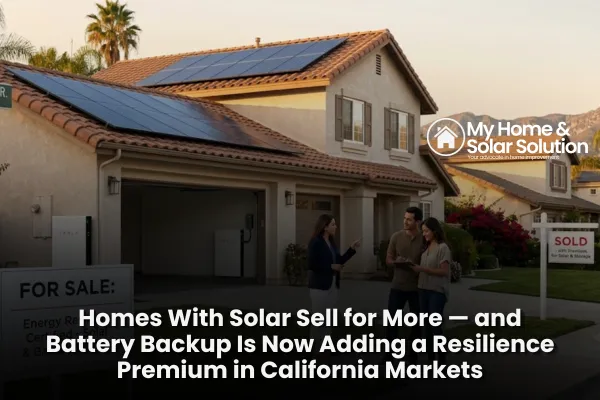
Homes With Solar Sell for More — and Battery Backup Is Now Adding a Resilience Premium in California Markets
Homes With Solar Sell for More — and Battery Backup Is Now Adding a Resilience Premium in California Markets
In California's real estate market, solar panels have graduated from a novelty to a broadly recognized value driver. Multiple studies — including research from the Lawrence Berkeley National Laboratory, Zillow, and the National Renewable Energy Laboratory — have documented a consistent solar premium: homes with solar sell for more than comparable homes without it. The average premium varies by region, home size, and system size, but studies have found that California homes with solar sell for $15,000–$29,000 more than comparable non-solar homes. That's a premium that, in many cases, exceeds the cost of the solar installation itself.
Now there's a second layer of value emerging in California's real estate market: battery backup. As PSPS events, wildfire risk, and grid reliability concerns have become regular features of California life, buyers are increasingly willing to pay a premium for homes that stay powered when the grid doesn't. Here's what the data shows, what's driving the battery premium, and how to think about solar-plus-battery as a real estate investment in Southern California.
The Solar Premium: What Research Has Found
The Lawrence Berkeley Lab study — which analyzed over 22,000 solar home sales across multiple states — found that buyers paid a premium of roughly $4/watt for solar systems. For a 7.5 kW system, that's a $30,000 premium. For a 5 kW system, approximately $20,000.
Zillow's analysis of solar home listings found that homes with solar sold for 4.1% more than comparable homes without it — translating to over $9,000 in additional value for the median U.S. home, and significantly more in California where median home prices are higher.
The premium is more pronounced in markets where electricity rates are high — because buyers recognize that the solar system offsets a significant ongoing expense. In SCE territory, where rates have climbed steadily, a solar system that saves $250/month represents $3,000/year in utility cost avoidance. Buyers implicitly capitalize that savings stream into the purchase price.
What TPO vs. Ownership Means for Resale Value
An important nuance: the solar premium applies most cleanly to owned or fully paid-off solar systems. When a solar loan is attached to the property, the lien must be paid off at closing, which reduces the seller's net proceeds. When a solar lease is in place, the buyer must agree to assume the lease — which some buyers are unwilling to do.
TPO programs structured as power purchase agreements that are freely transferable can be positioned as a benefit to buyers — they take over a below-market energy rate that continues for the remaining program term without qualification requirements. In a high-rate SCE environment, inheriting a fixed energy program at rates significantly below current utility prices is a tangible financial benefit.
The framing matters in listing and negotiation. A seller whose home has a solar-plus-battery system with a transferable energy program can legitimately represent it as a benefit to buyers who understand the California energy market.
The Battery Premium: A New Market Signal
Battery backup systems are beginning to appear as a distinct value-add in California real estate listings — particularly in communities with documented PSPS history, wildfire exposure, or grid reliability concerns.
The Ventura County market, which has experienced both direct wildfire impacts and PSPS events, is among the California markets where battery backup carries the clearest resonance with buyers. A home that stayed powered during the 2019 PSPS events — while neighbors were dark for 24–48 hours — has a differentiated story to tell.
The specific premium for battery storage hasn't been as rigorously quantified as the solar premium, but surveys of real estate professionals and buyer data suggest:
Buyers increasingly ask about backup power during showings in PSPS-affected communities. Listings that mention battery backup receive more interest in fire-adjacent and historically outage-prone neighborhoods. Homes with documented backup capability — particularly whole-home systems — can support higher asking prices in markets where the alternative is perceived as vulnerable. As PSPS events continue and their impact on daily California life becomes more widely understood, the battery premium is likely to grow.
The Investment Framing: Solar-Plus-Battery as a Financial Asset
For California homeowners evaluating solar-plus-battery investment, the financial case includes three components:
Monthly bill savings: Immediate, ongoing, and growing as utility rates increase. For most SCE customers, $150–300/month.
Home value premium: A one-time increase in home value reflected at sale. Research suggests $15,000–$29,000+ for properly documented systems in California.
Resilience value: Harder to quantify, but increasingly reflected in buyer willingness to pay — particularly in wildfire-exposed communities.
The combination produces a compelling investment case that isn't purely dependent on utility bill savings. Even in scenarios where bill savings alone don't produce a standard investment return, the home value premium changes the overall economics significantly.
What to Document for Maximum Resale Value
If you're a California homeowner with solar and batteries, documenting the system's value for future sale is worth the effort:
Keep all permits, interconnection agreements, and system warranties organized and accessible. Maintain records of utility bill history before and after installation, showing the actual savings achieved. If you have a monitoring app (Tesla app, Enphase Enlighten, etc.), export your production and savings history. Have the system inspected and certified as in good working order before listing. This documentation allows you to present the solar-plus-battery system not as an abstract feature but as a quantified financial benefit — one with a proven track record in your specific home.
My Home & Solar Solutions helps Ventura County homeowners access solar and battery backup programs that are structured to preserve and maximize home value. We advise on program structures, documentation practices, and how to present solar-plus-battery as a real estate asset.
Visit www.myhomesolution.org to learn more about our programs and how solar-plus-battery can benefit both your monthly bills and your home's long-term value.

