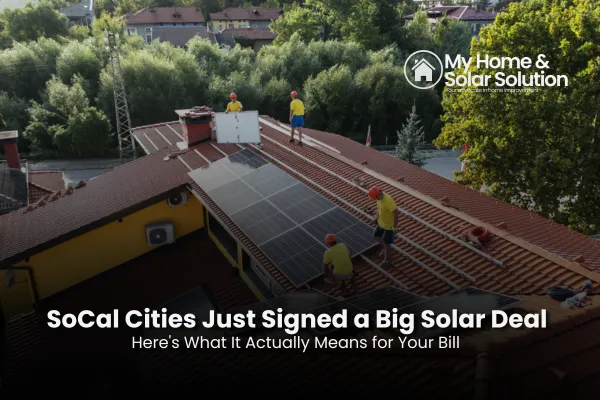
SoCal Cities Just Signed a Big Solar Deal — Here's What It Actually Means for Your Bill
SoCal Cities Just Signed a Big Solar Deal — Here's What It Actually Means for Your Bill
The Southern California Public Power Authority, a joint agency representing municipal utilities including Anaheim, Los Angeles, and Pasadena, has signed a power purchase agreement with EDF Renewables for a new utility-scale solar farm. It's part of a broader trend of municipal utilities across the region locking in long-term contracts for solar power, following a pattern that investor-owned utilities like SCE, PG&E, and SDG&E have been pursuing for years. For homeowners served by these municipal utilities, a new solar contract like this is generally good news for the region's overall electricity mix, but it's worth understanding what it does and doesn't do for an individual household's bill.
What municipal utility solar deals typically do and don't change
Municipal utilities, sometimes called "munis," operate differently than investor-owned utilities in important ways — they're publicly owned, often have different rate-setting processes, and in some cases have historically offered somewhat lower rates. But like investor-owned utilities, when a muni signs a long-term solar PPA, the contracted price gets blended into the utility's overall cost structure rather than passed directly to customers as savings tied to that specific project.
Why this still matters for the broader picture
A new long-term solar contract does help stabilize a portion of a utility's future power costs, since the price is often fixed for the life of the agreement rather than subject to fuel price volatility the way natural gas generation is. Over a long enough timeframe, that stability can help moderate future rate increases compared to a utility more heavily exposed to volatile fuel markets, even if the effect isn't immediate or dramatic on any single month's bill.
Lower your monthly electric bill by 50% without need to lease, finance or pay cash for solar + battery equipment
What this means for homeowners in a municipal utility's service area
Whether a homeowner is served by a municipal utility or an investor-owned one, the same basic dynamic applies: contracted utility-scale solar helps the grid overall, but it doesn't replace the value of generating and storing your own power at a fixed, known cost. Municipal utility customers evaluating solar and battery storage for their own homes should expect similar economics to what investor-owned utility customers see, since the underlying rate structures and cost pressures are broadly similar across California utilities.
Lower your monthly electric bill by 50% without need to lease, finance or pay cash for solar + battery equipment
If you're served by a municipal utility and want to understand how solar and battery storage could work for your own home, My Home & Solar Solutions can help you evaluate the options. Visit myhomesolution.org to learn more.

