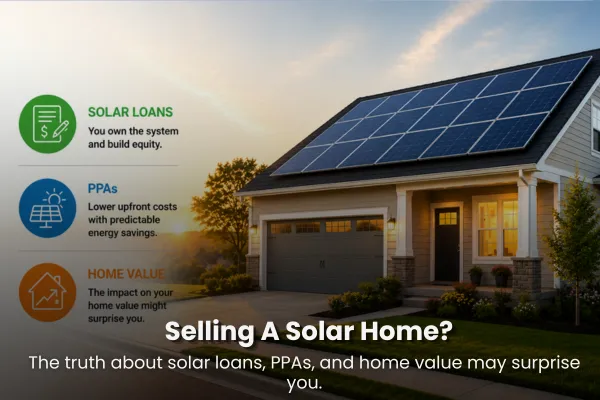
Selling A Solar Home? The truth about solar loans, PPAs, and home value may surprise you.
Selling A Solar Home?
The truth about solar loans, PPAs, and home value may surprise you.
You finally decide to sell your home. The listing photos look great. The rooftop solar panels gleam in the afternoon sun. You assume they're a selling point — a clean, modern upgrade that buyers will love. Then the questions start.
Who owns the panels? Is there a loan attached? Can the agreement transfer? What happens at closing? For a lot of California homeowners, the moment they try to sell is the moment they realize they never fully understood the contract under their own roof.
Solar can absolutely add value to a home. Research from Zillow has found that solar-equipped homes often sell for more than comparable homes without solar. But whether your solar helps or complicates a sale comes down almost entirely to one thing: how the system is owned and that is where many sellers get caught off guard.
There are several common ways homeowners have solar on their roof, and each one behaves very differently when it's time to sell:
Owned outright (cash or paid-off loan): Generally the simplest. The panels are part of the home and typically transfer with it, often adding to value.
Active solar loan: The remaining balance usually has to be paid off at closing or assumed by the buyer. Liens tied to the loan can complicate or slow the sale. Buyers not qualifying for the second solar loan kills the deal mid escrow.
Lease: The buyer typically must qualify and agree to take over the lease terms, which not every buyer is willing to do.
Power Purchase Agreement (PPA): Different then a lease — the buyer agrees to buy the power the system produces, usually at a set rate, for the remainder of the agreement. Easiest transfer for solar and as seen as benefit to potential buyer due to how low the kWh rate is.
None of these are inherently bad. But each creates different questions, different paperwork, and different buyer reactions.
The structure of your solar agreement matters as much as the panels themselves.
A solar loan, in particular, can create friction. Buyers may hesitate over the remaining balance, the lien on the property, or the process of assuming debt. Deals can slow down or fall through over details the seller never anticipated.
By contrast, third-party ownership structures like leases and PPAs avoid putting equipment debt on the homeowner in the first place — though they do require the buyer to accept the transfer.
This is exactly why understanding your agreement before you list is so important. The last thing any seller wants is a surprise during escrow.
For homeowners thinking about solar in the first place — especially with resale in mind — the ownership question is worth careful thought from the start.
Many California families are choosing third-party ownership programs specifically because they avoid equipment debt and the lien complications that can come with loans. Under a TPO structure, a separate company owns and maintains the system, the homeowner uses the power it produces, and there is no large upfront cost.
For homeowners weighing their options, it helps to know
* Whether the system is owned, financed, leased, or under a PPA
* What transfers to a buyer and what must be paid off
* How the agreement affects disclosure and closing
* Whether the structure adds value or adds friction at resale
* How TPO programs differ from loans when it comes time to sell
Solar should make your home more attractive, not more complicated. The difference comes down to knowing what you have and how it's structured — ideally long before the "For Sale" sign goes up. If you're considering solar and want a structure that keeps your home easy to sell while still lowering your energy costs, it's worth understanding your options before you commit.
To find out if your home qualifies for a TPO solar and battery program, visit https://myhomesolution.org/california_public_utility_commissions

