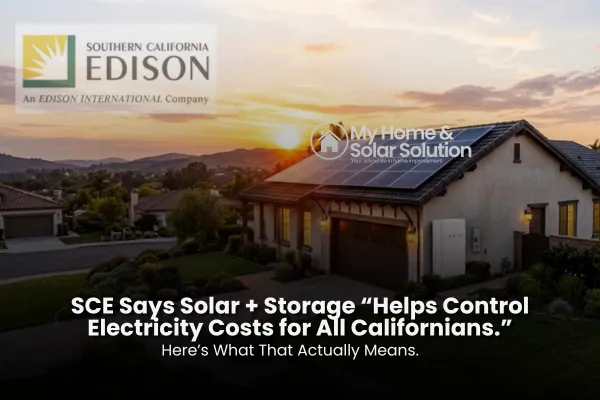
SCE Says Solar + Storage “Helps Control Electricity Costs for All Californians.” Here’s What That Actually Means.
SCE Says Solar + Storage "Helps Control Electricity Costs for All Californians." Here's What That Actually Means.
Southern California Edison has publicly stated that expanding solar and storage capacity helps control electricity costs for all Californians, framing it as a grid-wide benefit rather than just an individual homeowner's savings tool. It's a claim worth unpacking, because it's true in a specific, systemic sense that's easy to conflate with a more direct, individual promise that isn't quite what the statement means.
How solar and storage help control costs at the system level
When utilities add solar and battery storage to the grid, it reduces how often they need to run expensive peaker plants during high-demand periods, since stored solar can cover much of that peak demand instead. Peaker plants are some of the costliest generation resources utilities operate, often running only a small fraction of the year but commanding premium prices when they do. Reducing reliance on them helps moderate one of the more volatile cost drivers in a utility's overall generation expenses, which in turn can help moderate future rate increases across the entire customer base.
Why "helps control costs" doesn't mean "lowers your bill directly"
The statement is about slowing the rate of cost growth systemwide, not about generating savings that flow back to individual customers as a rebate or credit. A homeowner without solar doesn't see a line-item reduction because SCE added grid-scale storage; the benefit shows up, if at all, as rates rising somewhat more slowly than they otherwise would have, spread across millions of customers over years.
Why this distinction matters for homeowners evaluating solar
Understanding this distinction helps clarify why utility-scale solar and storage additions, even at significant scale, don't substitute for a homeowner's own decision about generating and storing their own power. Grid-level solar and storage is a genuinely useful tool for managing systemwide costs, but it operates on a completely different mechanism than a home system that directly offsets an individual household's own consumption. Net-Billing rate plan which leverages TPO companies that provide battery and solar equipment at no cost to the homeowner (assuming the home qualifies)
What this means for evaluating your own energy costs
If a homeowner is looking for a meaningful, direct reduction in their own monthly bill rather than a modest, systemwide moderation of future rate increases, the tools available are different: efficiency, usage timing, and — most directly — generating and storing electricity at home rather than relying entirely on the grid, however much solar and storage that grid has added at the utility level.
See if your home qualifies for free battery backup and NET-Billing electric bill discounts
If you want a direct, individual reduction in your own electricity costs rather than a systemwide moderation, My Home & Solar Solutions can help you evaluate a home solar and battery system. Visit myhomesolution.org to learn more.

