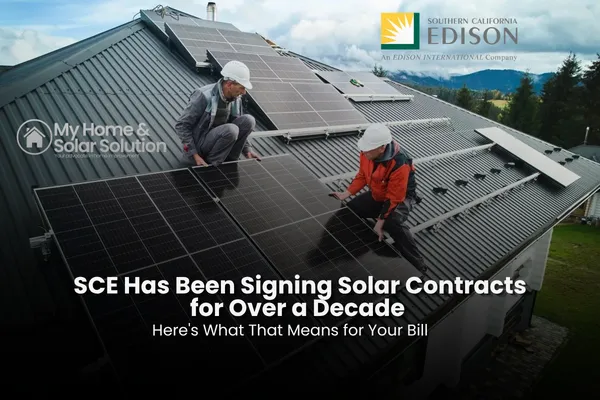
SCE Has Been Signing Solar Contracts for Over a Decade — Here's What That Means for Your Bill
SCE Has Been Signing Solar Contracts for Over a Decade — Here's What That Means for Your Bill
In 2013, Southern California Edison signed 20-year power purchase agreements for two 20-megawatt solar projects in Kern County — Wildwood Solar I and Pumpjack Solar I — each capable of supplying enough electricity for about 5,000 homes. It was one of dozens of similar utility-scale solar contracts SCE signed during the 2010s as California pushed utilities toward renewable energy targets. More than a decade later, those early contracts are still on SCE's books, and they offer a useful window into how utility-scale solar pricing has evolved — and why it matters for what you pay today. Lower your electric bill by 50% without leasing, financing, or paying cash for solar
The Economics Have Flipped
When SCE signed those 2013 contracts, utility-scale solar power purchase agreements were priced well above today's rates — often in the range of 10-14 cents per kilowatt-hour, reflecting the higher manufacturing and installation costs of solar technology at the time. Today, utility-scale solar PPAs routinely price below 3-4 cents per kilowatt-hour in many markets, a decline of more than 70% driven by falling panel costs, improved efficiency, and manufacturing scale. That means SCE — like most utilities — has a mix of solar contracts on its books priced at wildly different rates: expensive, decade-old agreements signed when solar was still an emerging technology, layered alongside much cheaper contracts signed more recently. Utilities blend the cost of this entire portfolio into the rates they charge customers, which is one of many factors contributing to today's electric bills. Lower your electric bill by 50% without leasing, financing, or paying cash for solar
Why This History Matters for Homeowners
This history is a useful reminder of something important: utility-scale solar contracts, no matter how favorable, don't directly translate into lower bills for you. The savings from newer, cheaper solar contracts get blended across a utility's entire cost structure — including far more expensive legacy contracts, wildfire mitigation spending, and infrastructure investment — rather than passed through directly to customers. Rooftop solar works differently. When you install solar on your own home, you're not relying on a utility to negotiate favorable contracts and pass savings through a rate structure with dozens of competing cost pressures. You're generating and, with a battery, storing your own power directly — locking in your own energy costs independent of what your utility pays for its broader generation portfolio. Lower your electric bill by 50% without leasing, financing, or paying cash for solar
As SCE and other California utilities continue blending old and new contracts into a single rate structure, the gap between what utility-scale solar actually costs today and what you pay on your monthly bill is likely to remain significant. That gap is part of why more California homeowners are choosing to generate their own power directly, rather than depend entirely on their utility's portfolio of contracts old and new.
My Home & Solar Solution can help you understand what solar and battery storage would mean for your specific home, independent of how your utility manages its broader contract portfolio. Visit myhomesolution.org to see the numbers for your house.

