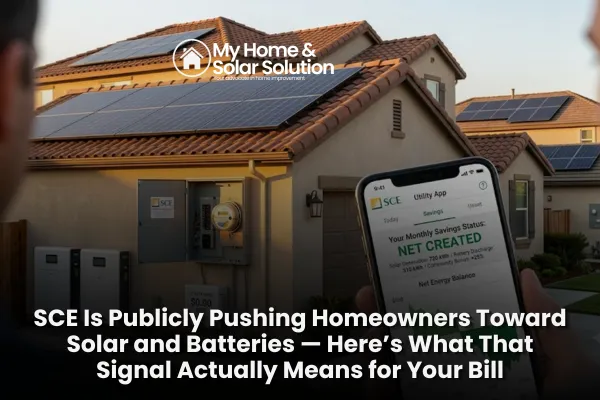
SCE Is Publicly Pushing Homeowners Toward Solar and Batteries — Here’s What That Signal Actually Means for Your Bill
SCE Is Publicly Pushing Homeowners Toward Solar and Batteries — Here's What That Signal Actually Means for Your Bill
Something unusual is happening in California's energy market. Southern California Edison — the utility that charges you for electricity — is actively encouraging its own customers to generate and store their own power. That's not the behavior of a company trying to protect its revenue stream. It's the behavior of a utility under regulatory and physical pressure that sees distributed solar and storage as part of the solution to a problem too big to solve with traditional infrastructure alone. Understanding why SCE is promoting solar and batteries — and what that means for you as a ratepayer — is important context for anyone considering going solar in Southern California.
Why a Utility Would Encourage You to Reduce Your Purchases
On the surface, a utility encouraging customers to buy less electricity seems counterintuitive. Less consumption should mean less revenue, right? The reality is more nuanced, and understanding it explains a lot about where California's energy market is heading.
SCE faces several converging pressures that make distributed solar and storage not just acceptable to the utility but genuinely valuable:
Peak demand management: SCE's most expensive and operationally difficult challenge is meeting peak demand — typically on hot summer afternoons when millions of air conditioners run simultaneously. Every home with a battery that discharges during the 4–9 PM peak is a home not drawing from the stressed grid during those critical hours. Distributed storage is one of the most cost-effective ways to manage peak demand — cheaper, in many cases, than building new peaking power plants.
Wildfire risk reduction: California utilities are legally and regulatory exposed to wildfire liability. Every PSPS event that de-energizes a distribution circuit to prevent sparks means thousands of customers without power — bad optics, customer complaints, and regulatory scrutiny. Homes with battery backup are homes that ride out PSPS events without generating the same customer hardship, which reduces pressure on the utility during shutoff events.
Renewable integration: California mandates that investor-owned utilities achieve 100% clean energy by 2045. Distributed rooftop solar is clean generation that reduces the utility's need to procure expensive renewable power from remote solar farms. Distributed storage smooths the intermittency of solar, making the overall grid easier to manage.
CPUC regulatory alignment: The CPUC has directed California utilities to support distributed energy resources and has set targets for grid-scale and distributed storage deployment. SCE's public encouragement of residential solar and batteries is, in part, regulatory compliance.
What SCE's Net Billing Structure Is Actually Telling You
The design of SCE's NEM 3.0 net billing program sends a clear signal about what behavior the utility and regulator want to incentivize. The program heavily penalizes export during midday peak solar generation hours — precisely because the grid doesn't need more power during those hours. It rewards self-consumption and storage — precisely because the utility does benefit from homes that reduce peak demand and manage their own load. In other words: the rate structure is designed to make solar-plus-battery the most economically advantageous choice for homeowners. When a policy is structured to reward a specific behavior, that's not coincidence. It's a signal.
SCE's public communications — its website, bill inserts, and customer education materials — encourage homeowners to explore solar, storage, and demand response programs. That's consistent with the utility's genuine interest in distributed load management.
The Implication for Your Bill: Acting With the Market, Not Against It
The key insight for California homeowners is this: when you go solar with battery storage, you're not fighting the utility. You're aligned with what the utility — and the broader California energy policy environment — is trying to accomplish. That alignment has practical benefits. Programs that support residential solar and storage are better funded, better regulated, and more stable than programs that are fighting the direction of utility policy. Your solar installer who understands the NEM 3.0 environment and designs for it is working with the current, not against it and from a pure bill reduction standpoint, the home that has solar and batteries is benefiting from both sides of the rate structure: generating power when the sun shines, storing it when it's surplus, deploying it when it's most valuable, and buying only off-peak grid power when necessary.
The Remaining Tension: Rate Design and Fixed Charges
It would be incomplete to suggest that SCE's incentives are perfectly aligned with every homeowner's interest. Fixed charges — the baseline monthly grid connection fee that doesn't vary with consumption — are increasing as utilities seek to recover infrastructure costs regardless of how much power customers buy. For solar homeowners, fixed charges represent the irreducible floor of utility cost — the amount they'll pay regardless of how much self-generation they achieve. Understanding how fixed charges affect your net savings from solar is part of the honest financial analysis My Home & Solar Solutions provides. The direction of policy, however, is clear. SCE is building a grid that accommodates and rewards distributed resources. Homes that participate in that grid — with solar and storage — are better positioned than those that remain fully dependent on utility supply.
What Qualifying Homeowners Should Do
If you're in SCE territory and your bill is over $150/month, the fact that SCE itself is encouraging solar and battery adoption is both validation of the technology's value and a practical signal that programs and incentives are available to support you.
My Home & Solar Solutions works with Ventura County homeowners to navigate the SCE rate environment, identify available programs, and design solar-plus-battery systems that work well under current and anticipated future rules.
Visit https://myhomesolution.org/southern-california-edison-net-billing to learn more about SCE's net billing structure and what it means for your household. When the utility is telling you to go solar, it's worth paying attention.

