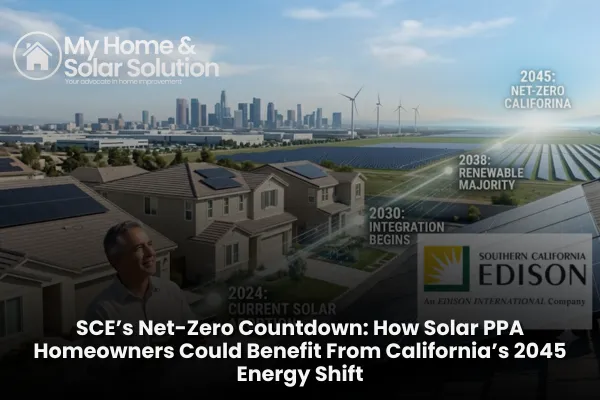
SCE’s Net-Zero Countdown: How Solar PPA Homeowners Could Benefit From California’s 2045 Energy Shift
SCE's Net-Zero Countdown: How Solar PPA Homeowners Could Benefit From California's 2045 Energy Shift
California's 2045 net-zero electricity mandate is the most ambitious clean energy commitment of any U.S. state. By 2045, every kilowatt-hour delivered to California customers must come from carbon-free sources — no exceptions, no offsets for legacy fossil fuel generation. Southern California Edison is building its long-range planning around this mandate. Its Pathway 2045 framework outlines a multi-decade transformation of the grid — from a centralized fossil-fuel-supported system to a distributed, renewable-rich network where solar, wind, battery storage, and demand flexibility work together to serve California's electricity needs reliably and cleanly. Within this transformation, homeowners who participate in solar power purchase agreement (PPA) or TPO programs may find themselves in a stronger position than they realize — not just financially, but structurally, as the grid evolves around their installed systems.
Understanding the Shift
The transition to net-zero electricity by 2045 involves a fundamental restructuring of how power is generated, moved, and consumed in California:
Generation shifts from large, centralized fossil fuel plants to distributed renewable sources — rooftop solar, utility-scale solar farms, offshore wind, and geothermal.
Storage shifts from fossil fuel "fuel tanks" (gas peaker plants standing by for peak demand) to chemical batteries — both grid-scale (like SCE's recently contracted storage assets) and residential (like the Powerwalls installed in California homes).
Demand flexibility becomes more important: as renewable generation fluctuates with weather and time of day, the grid increasingly needs consumers to shift their consumption patterns — charging batteries during cheap solar hours, avoiding peak demand periods — to match the variable supply profile.
In each of these areas, homes with solar PPA programs and battery storage are already positioned on the favorable side of the transition. They are, in effect, the future grid in miniature — distributed, storage-equipped, and capable of demand flexibility.
The PPA Structure and the 2045 Environment
A solar PPA agreement in California typically runs 20–25 years. A homeowner who signs a PPA in 2026 will still be operating under that agreement in 2046–2051 — after California's net-zero deadline has passed. During that time, California's electricity market will change dramatically. The cost structure of the grid — with its massive infrastructure investment in renewable integration — will be reflected in utility rates. The wholesale value of clean energy will evolve as the generation mix shifts. And the regulatory framework governing distributed energy resources will continue to be refined.
For homeowners in PPA programs, several of these shifts could create additional value:
Export value may increase at specific times: As California's grid becomes more reliant on intermittent renewables, the value of dispatchable distributed storage — home batteries that can export power when and where the grid needs it most — may increase. CPUC proceedings around distributed energy resource value are ongoing, and the trajectory generally rewards flexible storage. Demand response participation: SCE and other California utilities have demand response programs that pay customers for reducing or shifting their load during grid stress events. Homes with smart battery systems are well-positioned to participate in these programs, earning additional credits on top of bill savings. Grid services from batteries: As virtual power plant (VPP) programs expand — and they are expanding significantly in California — home batteries can be aggregated and operated as a grid resource during high-demand periods. Early participants in VPP programs have earned meaningful additional compensation on top of standard bill savings.
The Technology Maturity Advantage
Homeowners who go solar under PPA programs today are deploying technology that has reached full commercial maturity. Tesla Powerwall, Enphase, and other leading battery systems have years of real-world performance data, proven reliability records, and established warranty and support structures. As the 2045 deadline approaches and new storage technologies emerge — solid-state batteries, longer-duration storage, next-generation inverter technology — homes with existing systems will have options to upgrade selectively while maintaining the core of their installed infrastructure. The PPA structure is particularly advantageous here: under TPO, the program partner bears responsibility for equipment performance and, in some programs, for technology upgrades over the program term. Homeowners don't have to worry about whether their 2026 Powerwall is still the best option in 2036.
What This Means for Homeowners Today
The 2045 countdown isn't primarily a policy story. It's a financial story about who bears the cost of California's energy transition and who benefits from it.Homeowners who go solar under PPA programs in 2026 are enrolling in a cost structure that's fixed relative to a grid that will become increasingly expensive to participate in purely as a customer. They're positioning themselves on the generation side of California's energy economy rather than purely on the consumption side. Over 20 years — through California's net-zero transition — that positioning produces real, growing financial benefits while simultaneously contributing to the clean energy infrastructure the state needs to meet its mandate.
My Home & Solar Solutions helps qualifying California homeowners access TPO/PPA solar programs designed for the long-term California energy environment. We explain the 2045 context honestly, and we help homeowners understand how their participation in a solar PPA today connects to where California's grid is going over the next two decades.
Visit https://myhomesolution.org/southern-california-edison-net-billing to learn more. SCE's net-zero countdown is a policy milestone. For PPA homeowners, it's also an opportunity.

