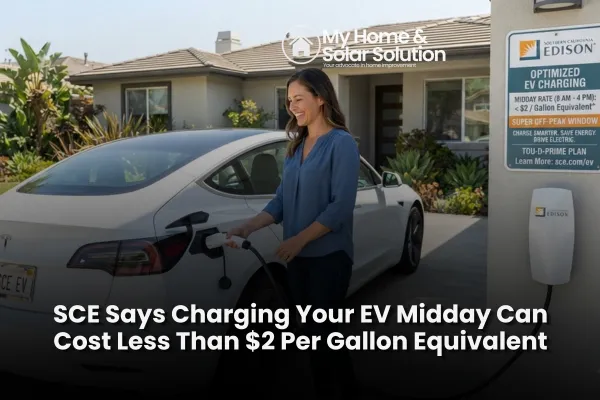
SCE Says Charging Your EV Midday Can Cost Less Than $2 Per Gallon Equivalent
SCE Says Charging Your EV Midday Can Cost Less Than $2 Per Gallon Equivalent
For homeowners weighing the cost of running an electric vehicle against a gas car, timing matters more than most people realize. SCE has highlighted that charging an EV between 8 a.m. and 4 p.m. under its current time-of-use rate plans can bring the effective per-gallon-equivalent cost below $2 — well under typical California gas prices, and a meaningful reminder that when you charge matters as much as how much you charge.
Why the 8 a.m. to 4 p.m. Window Is So Cheap
This midday window overlaps with the period when solar generation across the California grid is at its highest and overall electricity demand is comparatively low, since it falls before the evening peak driven by people arriving home from work and running air conditioning. Utilities price electricity lower during these abundant-supply hours specifically to encourage exactly this kind of usage shift — charging an EV, running appliances, or otherwise using more electricity when the grid has surplus capacity to spare.
How the Per-Gallon-Equivalent Math Works
Converting EV charging costs to a per-gallon-equivalent figure gives homeowners an intuitive comparison to gas costs. During the cheapest TOU windows, that comparison can come in well under $2 per gallon-equivalent, compared to California's typically much higher pump prices for regular gasoline. Charging during expensive peak hours instead, by contrast, can erode much of that cost advantage, sometimes bringing the effective cost close to or even above gas price parity depending on the specific rate plan and time.
Why This Matters Beyond EV Owners
This midday pricing pattern isn't just relevant for EV charging — it reflects the same underlying rate structure that makes solar and battery storage valuable for any electricity usage. The hours when EV charging is cheapest are the same hours when a home's own solar panels are producing the most power, meaning a household with solar can often charge an EV directly from self-generated electricity during this window at effectively no marginal grid cost at all.
Putting the Timing to Work
Homeowners who are already charging opportunistically, or who want to make sure they're capturing the cheapest possible charging window, benefit from either manually timing charging sessions or using a charger with scheduling capability to automate it. Combined with home solar production during those same hours, EV charging becomes one of the most cost-effective parts of a household's entire energy picture rather than an added expense.
My Home & Solar Solutions helps California homeowners design solar and battery systems that align with both household electricity needs and EV charging patterns to maximize savings during these low-cost hours. Visit myhomesolution.org to see how solar and smart EV charging could work together for your home.

