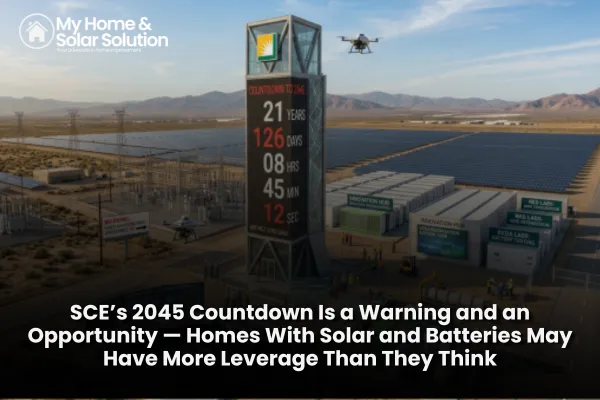
SCE’s 2045 Countdown Is a Warning and an Opportunity — Homes With Solar and Batteries May Have More Leverage Than They Think
SCE's 2045 Countdown Is a Warning and an Opportunity — Homes With Solar and Batteries May Have More Leverage Than They Think
California has set a hard deadline: 100% clean electricity by 2045. Southern California Edison, which serves millions of customers across one of the country's most populous and economically significant regions, is working toward that goal through a combination of utility-scale renewable procurement, grid modernization, and distributed energy resource deployment. The 2045 deadline is nearly 20 years away. But the decisions being made now — by regulators, by utilities, and by individual homeowners — will determine whether that deadline is met, what it costs to meet it, and who captures the benefits of California's energy transformation. For California homeowners, 2045 is both a warning and an opportunity.
The Warning: The Costs of Transition Are Landing Now
The 2045 clean energy target doesn't wait until 2044 to have financial consequences. The infrastructure investment required to achieve it is happening now, and the rate increases that reflect those investments are landing on homeowners now.
Transmission infrastructure: Moving renewable energy from remote generation sites (desert solar, offshore wind) to population centers requires new transmission lines — billions of dollars in capital that flows through rate cases into residential bills.
Distribution upgrades: Integrating distributed solar, EV charging, and home batteries into the distribution grid requires new smart technology, upgraded equipment, and real-time monitoring systems. These too are capital investments recovered through rates.
Renewable procurement at premium: Some of the clean energy SCE needs to meet its 2045 mandate — particularly offshore wind and long-duration storage — costs more than the fossil fuel assets it's replacing. That premium is partly socialized through rates.
Grid-scale storage: As California adds more solar, it needs more storage to address the evening gap between when solar generates and when people use power. Grid-scale battery contracts — which SCE and other utilities are signing at scale — add costs that flow through to residential rates.
All of these investments are genuinely necessary for California to achieve its clean energy goals. But they are not free, and residential customers are the primary source of cost recovery. The 2045 countdown isn't abstract future policy. It's the driver of rate increases you're already seeing, and will see for the next 20 years.
The Opportunity: Homes With Solar and Batteries Are Better Positioned.
Here's where the warning becomes an opportunity: the same clean energy transition that's driving up utility rates is creating a policy environment where homes with solar and battery storage have structural advantages over homes that remain fully dependent on the grid.
Advantage 1: Rate insulation. As infrastructure costs drive up utility rates, homes that generate 60–80% of their own electricity pay less in usage charges — which is where most of the rate increase burden falls. Fixed charges increase with infrastructure costs, but usage charges scale with how much grid power you buy.
Advantage 2: Policy alignment. The CPUC's net billing structure, distributed energy resource programs, and grid modernization initiatives all treat distributed solar and storage as assets worth supporting. Homes with batteries can participate in demand response programs, earn additional credits during grid stress events, and benefit from policy frameworks designed to reward distributed generation.
Advantage 3: Flexibility. As the grid's rate structure evolves — which it will, as the 2045 deadline approaches and distributed energy resources proliferate — homes with solar and battery management systems can adapt. Smart battery programming can respond to new incentive signals, new time-of-use structures, and new export opportunities as they emerge.
Advantage 4: Resilience. The transition to clean energy comes with near-term grid reliability challenges. Adding large amounts of intermittent renewable generation while retiring fossil fuel peakers creates periods of grid stress — heat waves, low-wind events, equipment failures — where reliable backup power has heightened value. Homes with batteries navigate these events independently.
What the 2045 Timeline Means for Your Decision Today
A solar system installed in 2026 will still be operating in 2051. The battery system will have been replaced at least once and potentially twice by 2045. The infrastructure you install now will outlast the clean energy transition itself — and the economics of that infrastructure will be shaped by the rate environment across the entire 25-year period.
Homeowners who install solar-plus-battery systems in 2026 will be:
Generating their own clean electricity through California's entire clean energy transition. Reducing their exposure to the rate increases that will fund that transition for everyone else. Operating systems that are increasingly aligned with the policy environment as 2045 approaches and clean energy infrastructure matures.
Homeowners who wait will pay full grid rates — including the infrastructure costs of California's transition — throughout the delay, and may ultimately go solar under less favorable program terms than are available today.
My Home & Solar Solutions and the Long View
We help Ventura County and Southern California homeowners think about solar with the same long-term horizon that California's clean energy policy demands. We present the 2045 context, the rate trajectory, the program terms currently available, and the specific savings projections for each homeowner's situation.
For qualifying homeowners, TPO programs with no upfront cost are available now. The 2045 deadline is 19 years away. The decision to be part of the solution — and to capture the financial benefits of doing so — can be made today.
Visit https://myhomesolution.org/southern-california-edison-net-billing to learn how SCE's 2045 clean energy commitment affects your current rate environment and what solar-plus-battery looks like under that trajectory. The countdown is running. Your home can be on the right side of it.

