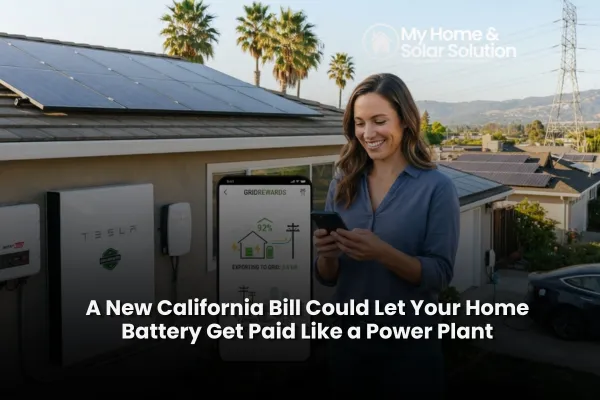
A New California Bill Could Let Your Home Battery Get Paid Like a Power Plant
A New California Bill Could Let Your Home Battery Get Paid Like a Power Plant - and the best part is you don’t have to buy the battery
California legislators are advancing a bill, SB 913, that would let home batteries and EV chargers directly compete in the state's Resource Adequacy markets — the same markets where traditional power plants get paid to guarantee the grid has enough capacity available when it's needed most. If it becomes law, this would meaningfully expand how homeowners with battery storage can earn money from equipment they already own or are considering installing.
What Resource Adequacy Markets Actually Are
Resource Adequacy, or RA, is the regulatory framework California uses to ensure there's always enough electricity generating capacity available to meet peak demand, particularly during high-stress periods like summer heat waves. Utilities and other electricity providers are required to procure enough RA capacity to cover their expected peak load, and they pay generators — traditionally power plants — for the right to call on that capacity when needed. Historically, participating in RA markets has required scale and infrastructure well beyond what an individual homeowner could access.
How SB 913 Would Change That
SB 913 aims to open a path for aggregated distributed energy resources, meaning networks of home batteries and EV chargers coordinated together, to qualify as legitimate RA capacity providers, similar to how virtual power plant programs already let batteries respond to grid events. The key difference is that RA market participation could offer more structured, potentially more lucrative compensation than typical event-based VPP payments, since RA capacity commitments are a core, ongoing need for grid reliability rather than an occasional emergency response.
Why This Could Matter More Than Existing VPP Programs
Current virtual power plant programs generally pay homeowners for discrete moments when their battery responds to a grid event. RA market participation, if SB 913 passes and is implemented, could create a more predictable, capacity-based revenue stream — essentially getting paid for making capacity available, whether or not it's ever actually called on during a given period, similar to how a traditional power plant gets compensated.
What Homeowners Should Watch For
SB 913 is still moving through the legislative process, and implementation details, including exactly how individual homeowners would enroll and get compensated, will depend on rules developed after any bill passes. For homeowners currently deciding whether to add battery storage, this legislation is a signal that policy is moving toward making batteries even more valuable participants in the broader grid, not less.
My Home & Solar Solutions stays current on legislation like SB 913 and helps California homeowners design battery systems ready to take advantage of new compensation programs as they become available. Visit myhomesolution.org to learn how to position your home battery for both today's programs and tomorrow's.

