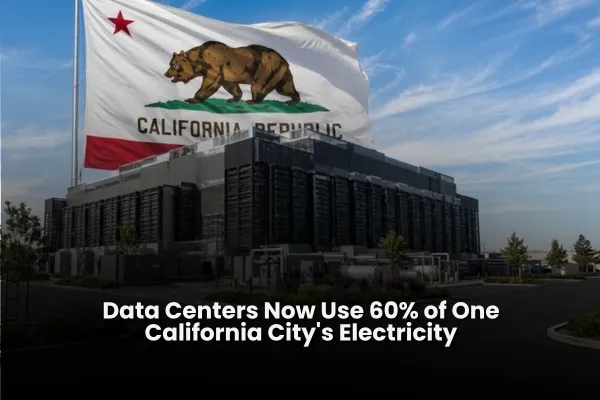
Data Centers Now Use 60% of One California City's Electricity
Data Centers Now Use 60% of One California City's Electricity
In Santa Clara, the heart of Silicon Valley, data centers are no longer a small part of the local power picture. They are the majority of it. Data centers now consume about 60 percent of the electricity sold by Silicon Valley Power, the city's municipal utility.
A county leading the nation
Santa Clara County now has 75 data centers, second only to Loudoun County, Virginia, among all U.S. counties. The county's count grew 23 percent from 2025 to 2026, the fastest growth rate among the five counties with the most data centers. Silicon Valley Power's total electricity sales grew from about 2,400 gigawatt-hours in 2002 to about 4,500 gigawatt-hours in 2024. If data centers use about 60 percent of that, it comes to roughly 2.7 billion kilowatt-hours a year. At 8,000 kilowatt-hours per home, that is as much electricity as about 337,500 homes.
Paying for the upgrades
Growth like that requires major investment in the grid. In July 2026, the Santa Clara City Council approved a $350 million revolving credit line for utility upgrades. Data centers also generate about 13 percent of the city's general fund revenue, which shows how tied the city has become to the industry. The question every homeowner should ask is simple: when the grid has to grow to keep up with data centers, who ends up paying for it?
Could your city be next?
Santa Clara is an extreme case, but it is a preview of what rapid data center growth can look like. Across California, developers have asked PG&E for about 15,000 megawatts and Southern California Edison for nearly 5,000 megawatts. Data centers are already concentrated in Los Angeles, San Francisco, San Diego and San Jose. When large loads arrive, utilities build new lines and substations, and those costs flow into rates over time. State consumer advocates have warned that ratepayers could be left covering costs if projects fail to deliver the revenue utilities expect.
Choosing your side of the meter
As demand grows, homeowners will end up on one of two sides. On one side, you keep buying every kilowatt-hour at whatever rate the utility sets. On the other, you produce your own power with solar, store it in a battery for the expensive evening hours, and send extra energy back to the grid for compensation. Some homeowners do not like the idea of supplying a grid that powers data centers. But it is better than being on the other side of the meter, competing with them for the same electricity.
Getting there without a big purchase
Qualifying California homeowners can get solar and battery storage through third-party ownership programs without buying or financing equipment. The system serves the home first, and extra power earns bill credits when it flows back to the grid. California's new SB 913 also directs regulators to set a value for battery power sent to the grid during high demand.
The takeaway
In Santa Clara, data centers already use most of the city's electricity. Homeowners anywhere in California can protect themselves by producing and storing their own power, with savings that can reach up to 40 percent compared with utility rates, depending on the home and program.
To find out if your home qualifies for a TPO solar and battery program, visit myhomesolution.org/california_public_utility_commissions

