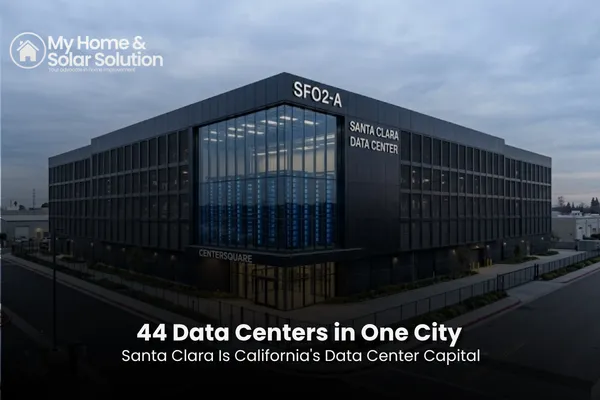
44 Data Centers in One City Santa Clara Is California's Data Center Capital
44 Data Centers in One City
Santa Clara Is California's Data Center Capital
If California has a data center capital, it is Santa Clara. The city has 44 listed data centers, more than any other city in the state. Los Angeles is a distant second with 19, followed by San Francisco and San Diego with 12 each and San Jose with 10.
How Santa Clara got here
Santa Clara sits at the center of Silicon Valley, with dense fiber networks, proximity to major tech companies, and its own municipal utility, Silicon Valley Power. Those advantages made it a magnet for colocation companies like Digital Realty, Equinix, CoreSite and Vantage, as well as cloud giants like Amazon Web Services.
Santa Clara County now has 75 data centers, second only to Loudoun County, Virginia, nationwide. Its count grew 23 percent from 2025 to 2026.
What it means for the local grid
Data centers now use about 60 percent of the electricity sold by Silicon Valley Power. That is roughly 2.7 billion kilowatt-hours a year, or about 337,500 homes' worth of electricity at 8,000 kilowatt-hours per home.
To keep up, the city approved a $350 million revolving credit line for utility upgrades in July 2026. Data centers also bring in about 13 percent of the city's general fund revenue, which shows how central they have become to the local economy.
Lessons for the rest of California
Santa Clara shows how quickly data centers can come to dominate a local power system. With developers asking PG&E for about 15,000 megawatts and Southern California Edison for nearly 5,000 megawatts, other regions may see similar pressure. Every new large load requires grid investment, and those costs tend to show up in rates over time.
Protecting your home from peak prices
The most expensive electricity for SCE, SDG&E and PG&E customers usually comes in the late afternoon and evening. Homes with solar and batteries can store their own midday solar and use it during those hours instead of buying from the grid. When they produce more than they need, extra power flows back to the grid and earns bill credits.
Choosing your side of the meter
As AI drives demand, homeowners will either keep buying power or start supplying it. Some people do not like the idea of supporting a grid that serves data centers. But being a supplier is better than paying peak prices while competing with them. Qualifying homeowners can get solar and battery storage through third-party ownership programs without buying or financing equipment. California's SB 913 also directs regulators to value battery power sent to the grid during high demand.
The takeaway
Santa Clara is a preview of what data center growth looks like. Homeowners can prepare by producing and storing their own power, with savings that can reach up to 40 percent compared with utility rates, depending on the home and program.
To find out if your home qualifies for a TPO solar and battery program, visit myhomesolution.org/california_public_utility_commissions

