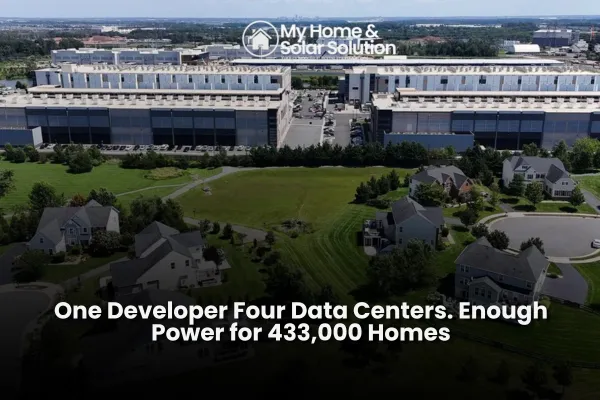
One Developer Four Data Centers. Enough Power for 433,000 Homes
One Developer Four Data Centers. Enough Power for 433,000 Homes
Prologis is best known as one of the world's largest owners of warehouses and logistics buildings. In Santa Clara, it is also planning four data center projects, each rated at about 99 megawatts, for a combined total of about 396 megawatts.
How big is 396 megawatts?
At full power year-round, 396 megawatts adds up to about 3.5 billion kilowatt-hours. At an average of 8,000 kilowatt-hours per home, that is roughly 433,600 homes' worth of electricity, from one developer in one city.
Real estate developers are joining the race
Prologis is part of a broader trend. Data centers are no longer built only by tech companies. Real estate developers, investment firms and colocation landlords are all building facilities to lease to cloud and AI companies. In Santa Clara, data centers already use about 60 percent of the electricity sold by the city's municipal utility, and the county's data center count grew 23 percent in a single year. Statewide, data center developers have asked PG&E for about 15,000 megawatts of power.
What it means for ratepayers
When hundreds of megawatts of new demand arrive, the grid needs new lines, substations and generation. In July 2026, Santa Clara approved a $350 million revolving credit line for utility upgrades. Across California, consumer advocates have warned that ratepayers could be left paying for infrastructure if large projects fall short of expected revenue.
Data centers can also run around the clock at high utilization, adding to demand during the evening hours when electricity is most expensive.
Your side of the meter
Every homeowner is going to be on one side of the meter as AI drives up demand. Homes that only buy power are exposed to rising costs. Homes that produce and store their own power use their own energy in the evening and send extra electricity back to the grid for compensation.
Supplying the grid that powers data centers may not feel ideal. But it is better than being on the buying side, competing for the same electricity.
Getting solar and storage without a big purchase
Qualifying homeowners can get solar and battery storage through third-party ownership programs without buying or financing equipment. Many agreements include maintenance and battery replacement for the term, offer a rate designed to come in below utility rates, and can transfer to a new owner if the home sells.
The takeaway
One developer is planning enough data center capacity to power hundreds of thousands of homes. Homeowners can plan for their own future with savings that can reach up to 40 percent compared with utility rates, depending on the home and program.
To find out if your home qualifies for a TPO solar and battery program, visit myhomesolution.org/california_public_utility_commissions

