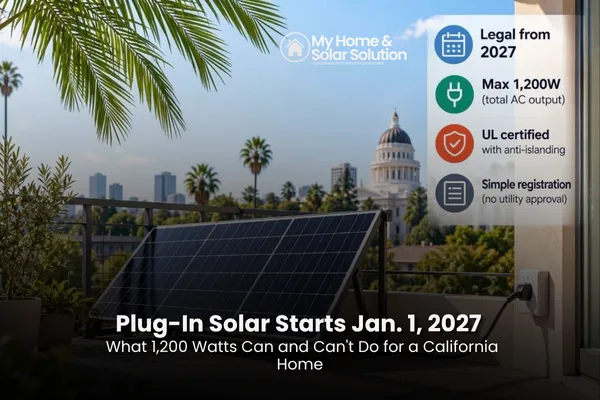
Plug-In Solar Starts Jan. 1, 2027 What 1,200 Watts Can and Can't Do for a California Home
Plug-In Solar Starts Jan. 1, 2027
What 1,200 Watts Can and Can't Do for a California Home
Beginning January 1, 2027, Californians will be able to plug small solar systems directly into a standard household outlet. Senate Bill 868, signed by Governor Gavin Newsom, allows up to 1,200 watts of total AC plug-in solar output per single dwelling, with no traditional utility interconnection application required. It is a good development for renters and apartment residents who cannot install rooftop panels. But many homeowners are already asking whether plug-in solar could replace a full system. Here is a clear look at what these small units can and cannot do for a California home.
What 1,200 watts can do
A plug-in system can offset a small portion of daytime electricity use. Analysis cited during the bill's debate estimated that a single 400-watt system could cover about 14 percent of an average apartment's usage and save roughly $250 a year. For a renter with a sunny balcony, that is a helpful reduction.
What 1,200 watts cannot do
It cannot keep your power on in an outage. SB 868 requires plug-in systems to automatically shut down when the grid goes down. During a public safety power shutoff, a wildfire-related outage, or a heat-wave emergency, a plug-in panel provides no backup power for your refrigerator, lights, Wi-Fi, or medical equipment. It cannot cover the expensive evening hours. Plug-in panels produce power only while the sun is up. On SCE, SDG&E, and PG&E time-of-use plans, the highest prices typically land between 4 p.m. and 9 p.m., right when solar production fades. Without a battery, a plug-in system does nothing for those hours. It cannot make a major dent in a typical homeowner's bill. A single-family home with air conditioning, a pool pump, or an electric vehicle uses far more electricity than an apartment. The maximum 1,200 watts would offset only a small slice of that.
Do not try to stack multiple units
Some homeowners may be tempted to buy several plug-in kits and spread them across different outlets. The 1,200-watt cap applies to the entire dwelling, so exceeding it is not allowed. More importantly, ordinary household circuits are not designed to accept power from multiple generating sources. Overloading them can damage wiring, trip breakers, harm your electrical panel, and create a fire risk. Electrical repairs can quickly cost more than any savings the units would produce. Rooftop systems are engineered, permitted, and inspected to connect safely to your home.
The bigger opportunity for homeowners
California's long-term energy plans depend heavily on home solar and storage. Southern California Edison's Countdown to 2045 analysis projects electricity demand will grow by roughly 80 percent by 2045 as the state works toward carbon neutrality. Meeting that demand with clean power means connecting large amounts of solar and batteries, including those on customers' homes. That is why a full rooftop solar and battery system is the real upgrade for homeowners. It covers a much larger share of your usage, stores energy for peak hours, and keeps essential loads running when the grid goes down.
No need to buy or finance the equipment
Through third-party ownership programs, qualifying homeowners can receive a complete solar and battery system without buying or financing the equipment, installation, or maintenance. Eligibility depends largely on your home and usage. Once installed, you benefit from lower energy costs, backup power, and the opportunity to participate as compensation for energy sent back to the grid expands. Plug-in solar is a welcome option for renters. If you own your home and want meaningful savings and protection, it is worth seeing what a full system could do for you.
To find out if your home qualifies for a TPO solar and battery program, visit myhomesolution.org/california_public_utility_commissions

