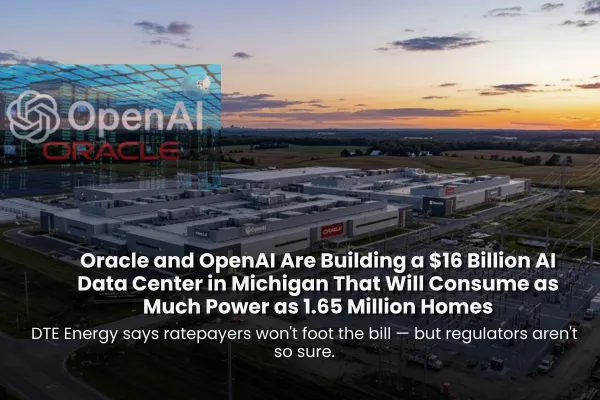
Oracle and OpenAI Are Building a $16 Billion AI Data Center in Michigan That Will Consume as Much Power as 1.65 Million Homes - DTE Energy says ratepayers won't foot the bill — but regulators aren't so sure.
Oracle and Open AI Are Building a $16 Billion AI Data Center in Michigan That Will Consume as Much Power as 1.65 Million Homes**
DTE Energy says ratepayers won't foot the bill — but regulators aren't so sure, and the same pressure is already reaching California homeowners.
There is a building going up in Saline Township, Michigan that most Americans have never heard of. It doesn't have a corporate name on the outside. Locals call it "The Barn." And when it is fully operational, it will consume roughly 41% of the electricity used by every household in the state of Michigan — combined.
That number is not a typo. The Barn is a $16 billion AI data center campus being developed by Related Digital for Oracle and OpenAI as part of the Stargate initiative — the massive national push to build artificial intelligence computing infrastructure across the United States. The financing deal closed on April 30, 2026, backed by funds connected to Blackstone and long-term debt managed by PIMCO. When complete, it will include more than 1.65 million square feet of data center space across three large buildings and it will need approximately 1.4 gigawatts of electricity to run.
To put that in terms most households can actually feel: the average Michigan home uses about 618 kilowatt-hours of electricity per month. The Barn's continuous power demand works out to roughly 12.26 billion kilowatt-hours per year — the equivalent of powering approximately 1.65 million Michigan homes at the same time.
Michigan has about 4.04 million households. That means a single AI data center will draw power equal to what 41% of all households in the state use — every hour of every day.
This is not a distant, abstract problem. It is the clearest illustration yet of how AI infrastructure is reshaping the cost and availability of electricity for everyday families. The road to this point was not smooth. Local officials in Saline Township rejected the rezoning in September 2025. Related Digital sued the township. The township later settled, and construction began in November 2025. The project is moving forward. The power demand is real and the question of who ultimately pays for the infrastructure to support it is very much unresolved.
DTE Energy, the utility supplying 100% of the electricity for the site, says the power will come from existing grid resources with added project-funded battery storage. DTE says homeowners will not pay extra.
Regulators are not convinced.
When a single facility draws 1.4 gigawatts from a regional grid, the math of grid capacity, transmission, and peak-demand management changes for everyone connected to that grid. Whether the costs show up directly in a rate case or indirectly through infrastructure upgrades spread across the customer base, regulators are right to ask the question.
They have seen this pattern before.
In Georgia, proposed grid expansion to support AI data centers has already raised concerns about future residential rate pressure. Reporting has found that electricity costs in areas near major data center activity have surged dramatically over just a few years. Even the Federal Reserve has flagged AI infrastructure as a potential driver of broader electricity price inflation. The Barn is not a one-off. It is part of a national buildout.
Because today's utility bill is no longer shaped only by how much electricity a household uses.
It is increasingly shaped by:
* Grid modernization and transmission costs
* Wildfire mitigation investments
* Aging infrastructure replacement
* Electrification planning
* Expanding demand from EVs and AI data centers
* Time-of-use peak pricing
For California homeowners on SCE, SDG&E, and PG&E, this matters even if Michigan feels far away. California is one of the largest AI infrastructure markets in the country. Data centers are expanding across the state. The pressure that Michigan ratepayers may be about to feel is a version of what California families are already experiencing. That is why more homeowners are asking a different question:
How do we [regain control over the cost of powering our homes](https://myhomesolution.org/home-7068)?
Increasingly, many are turning toward solar and battery storage. Not simply as an environmental choice. But as a financial protection strategy. The logic is straightforward. Solar panels generate electricity during the day from a source no data center can compete for. A battery stores that energy and deploys it during the hours when grid demand — and grid prices — peak. The home draws less from the utility at exactly the moments the utility is under the most pressure.
According to the [California Public Utilities Commission](https://www.cpuc.ca.gov/industries-and-topics/electrical-energy/demand-side-management/customer-generation/net-energy-metering-and-net-billing), export compensation for solar energy is typically lower than retail electricity prices. That makes battery storage increasingly valuable, because it lets homeowners store daytime solar and use it later during expensive evening hours rather than exporting it at low rates.
[**Battery-backed solar systems can help families:**](https://myhomesolution.org/home-7068)
* Reduce peak-hour grid imports when AI and industrial demand drive rates highest
* Insulate monthly energy costs from infrastructure investments passed through to ratepayers
* Provide backup power during outages that become more likely as grid stress increases
* Shift energy usage away from the most expensive peak-rate periods
* Generate clean electricity locally rather than depending entirely on a strained grid
For many homeowners, the goal is becoming less about eliminating a utility bill entirely and more about creating predictability in an increasingly unpredictable energy market and the most common barrier — the large upfront cost of a system — no longer has to stand in the way.
Qualifying homeowners served by SCE, SDG&E, or PG&E may be able to access [third-party ownership solar and battery programs](https://myhomesolution.org/home-7068) with no large upfront equipment purchase. A separate company owns and installs the system, the homeowner uses the power it produces, and there is no equipment debt or maintenance responsibility.
The Barn will be built. The 1.4 gigawatts will be drawn. And the debate over who pays for the infrastructure to support it will play out over years, not months.
In the meantime, the families who act now — reducing grid dependence before the next round of rate increases — are the ones who will feel it least.
The AI buildout is happening with or without any individual homeowner's approval.
The real question is whether your home is positioned to absorb its costs, or insulated from them.
To find out if your home qualifies for a TPO solar and battery program, visit [myhomesolution.org](https://myhomesolution.org/home-7068)
Additional resources:
[CPUC Net Billing Information](https://www.cpuc.ca.gov/industries-and-topics/electrical-energy/demand-side-management/customer-generation/net-energy-metering-and-net-billing)
[CPUC Electric Rate Information](https://www.cpuc.ca.gov/industries-and-topics/electrical-energy/electric-rates)
[My Home & Solar Solution News](https://news.myhomesolution.org/news)
[Learn More About Solar + Battery Programs](https://myhomesolution.org/home-7068)

