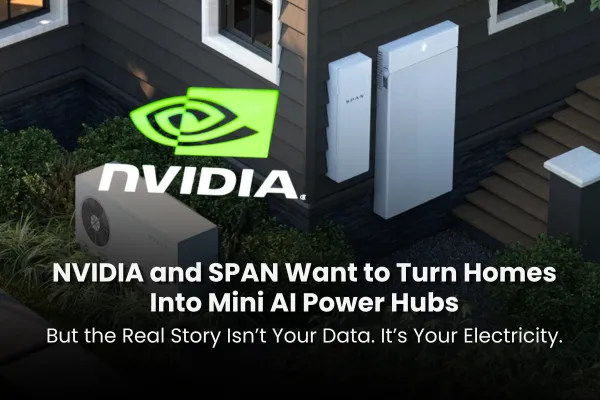
NVIDIA and SPAN Want to Turn Homes Into Mini AI Power Hubs, But the Real Story Isn’t Your Data. It’s Your Electricity.
NVIDIA and SPAN Want to Turn Homes Into Mini AI Power Hubs, But the Real Story Isn’t Your Data. It’s Your Electricity
When homeowners hear that NVIDIA is working with SPAN on a plan to place mini AI data centers at residential homes, the first reaction may be: “Is Big Tech trying to spy on me?” But this story is not mainly about your personal data. It is about something much more physical: your home’s electrical capacity.
SPAN has announced XFRA, a distributed data-center concept that uses SPAN smart electrical panels, battery backup, and NVIDIA-powered compute nodes to run AI workloads from homes and small commercial properties [1]. Instead of building every new AI data center from scratch, the idea is to use underutilized electrical capacity already sitting at the edge of the grid, including inside residential neighborhoods [1]
In simple terms, your home could become part of a distributed AI infrastructure network. The power still comes from the utility grid, flows through the home’s meter and electrical panel, and is then managed by the SPAN Panel to serve both household loads and the XFRA compute node. The compute node uses NVIDIA GPUs to process AI workloads for paying customers, while SPAN positions the homeowner benefit as discounted electricity, internet, smart-panel technology, and battery backup [2]
The Real Question: Who Pays for the Power?
If the homeowner pays for all the incoming power and only receives a small discount, the deal becomes much less compelling.
Before any homeowner agrees to host an AI data center on their property, they would need to know exactly how much electricity that system is going to pull, who controls it, and who is financially responsible for the added usage.
Because at the end of the day, the utility only sends what the home requests. If more loads are added to the home, whether that is an EV charger, a pool pump, a battery, or an AI compute node, that energy has to come from somewhere.
If the home does not have solar producing energy on-site, then that extra electricity is coming from the utility grid. That means the homeowner could be forced to buy more power from a monopolized utility, at rates they do not control, with prices that historically continue to move upward.
Sources numbered in body and listed at end
That is where homeowners need to be careful. You do not want to buy expensive utility power just so another company can use your home to generate revenue, then give you a small discount in return.
The Homeowner Needs Control
The real protection for homeowners is control.
If you control the source of your power, you have more control over your finances. If you can lock in the rate at which energy is generated and sold to your home, you are no longer completely exposed to utility rate increases, peak pricing, and unpredictable monthly bills.
That is why the homeowner conversation should not just be about smart panels or AI data centers. It should be about energy control.
SPAN says XFRA can help utilities manage peak demand and defer expensive infrastructure upgrades by using underutilized grid capacity more efficiently [1]. But from the homeowner’s perspective, the key question is different: does this lower my cost, protect me from rate increases, and keep me powered during outages?
If the answer is unclear, the homeowner should slow down.
A Cleaner Alternative: Solar + Battery PPA
There is already a simpler way for homeowners to gain control over energy costs, create a little extra income, and stay powered through blackouts without turning their house into a mini AI power plant.
A solar + battery PPA allows homeowners to get solar panels and battery backup with no upfront equipment purchase. The homeowner can buy solar energy at a fixed rate, use stored battery power during outages, and potentially earn income from energy events when the battery supports the grid.
For homeowners who want passive income and battery backup, a solar + battery PPA is the simpler, cleaner version: no equipment purchase, fixed-rate energy, backup power, and potential grid-event earnings without turning the home into an AI data center.
The difference is simple:
SPAN/XFRA model:
Use your home’s electrical capacity to power someone else’s AI business.
Use your roof and battery to control your own energy costs first. So Cal Edison and other CA utilities leverage the PPA program to service their customers.
NVIDIA and SPAN’s partnership shows where the energy conversation is heading. AI demand is growing so fast that companies are now looking beyond traditional data centers and into homes, neighborhoods,
Sources numbered in body and listed at end and existing electrical infrastructure [1]
But homeowners should not confuse hosting AI infrastructure with saving energy. The homeowner benefit only makes sense if SPAN, not the homeowner, absorbs the added electricity cost from the AI node. If the homeowner is still paying the utility for every kilowatt-hour coming through the meter, then the compensation needs to be large, transparent, and guaranteed. The future of energy is not just about using more electricity. It is about who controls the power, who controls the rate, and who gets the financial benefit.
For homeowners, the smartest move is to put themselves in control before their home becomes part of someone else’s energy strategy.
Sources
[1] SPAN Announces XFRA, a Distributed Data Center Solution: https://www.span.io/blog/span-announces-xfra-a-dis
tributed-data-center-solution-to-close-the-speed-to-power-gap-for-ai-compute-demand
[2] Latitude Media: Can Span turn homes into AI inference hubs?:
[3] pv magazine USA: SPAN and NVIDIA to develop AI data centers in your backyard: https://pv-magazine-usa.com/
2026/04/15/span-and-nvidia-to-develop-ai-data-centers-in-your-backyard-lowering-electric-bills/

