What Big Businesses Already Know About Microgrids How Homeowners Can Build Their Own
What Big Businesses Already Know About Microgrids
How Homeowners Can Build Their Own
Schools, municipal utilities, remote marinas, and industrial sites have been quietly investing in microgrids for years. Companies like Caterpillar now offer complete hybrid microgrid systems designed to keep critical facilities running, cut energy costs, and reduce reliance on the utility grid. The same idea is now within reach for California homeowners.
What a microgrid is
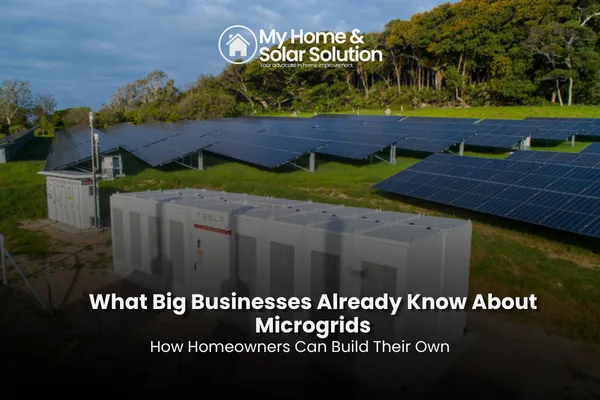
A microgrid is a self-sufficient energy system that can generate its own power and operate either connected to the utility grid or independently from it. Caterpillar describes its hybrid systems as combining several core components. Solar panels designed for reliability in extreme climates, with the ability to keep operating in island mode during outages. Battery energy storage that provides backup power, stabilizes supply, and shifts energy from the time it is produced to the time it is needed. A master controller that acts as the command center, coordinating energy sources and deciding when to use, store, or draw power. Backup generation, such as generators, for extended needs.
Why businesses invest in them
The benefits Caterpillar highlights are the same ones every homeowner wants: improved efficiency without depending entirely on the grid, power generated at the point of use, more use of renewable energy, and the ability to manage peak demand. Real projects include school campuses that pair renewables with standby power, remote marinas that significantly reduced fuel costs, and municipal utilities that manage peak demand more efficiently. Businesses do not invest in microgrids because it is trendy. They do it because an outage is expensive and peak-hour power is costly.
The home version of a microgrid
A homeowner does not need industrial equipment to get the same benefits. A rooftop solar system paired with a home battery and smart controls is essentially a residential microgrid. Solar panels generate power during the day. The battery stores it for the evening, when time-of-use prices on SCE, SDG&E, and PG&E are highest. The system's controls decide when to use solar directly, when to store it, and when to draw from the grid. And when the grid goes down, whether from a heat wave, wildfire, or public safety power shutoff, the system isolates your home and keeps essential loads running. New technology is making this even easier. Devices that install behind the electric meter can now enable whole-home battery backup with less electrical work, and all three of California's major utilities have approved them.
Building yours without buying equipment
Through third-party ownership programs, qualifying homeowners can get solar and battery storage installed without buying or financing equipment, while enjoying lower energy costs and backup power. Big businesses build microgrids for independence and resilience. Your home can have the same advantages. See whether you qualify.
To find out if your home qualifies for a TPO solar and battery program, visit myhomesolution.org/california_public_utility_commissions

