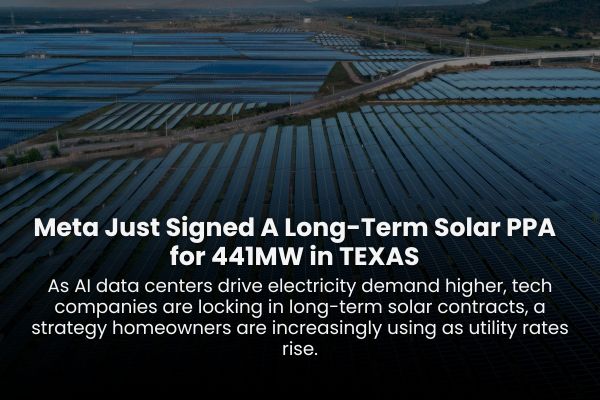
Meta Just Signed A Long-Term Solar PPA for 441MW in TEXAS
As AI data centers drive electricity demand higher, tech companies are locking in long-term solar contracts, a strategy homeowners are increasingly using as utility rates rise.
Artificial intelligence is transforming technology — but it’s also transforming the energy system that powers the modern world.
As AI-driven data centers expand, technology companies are racing to secure enormous amounts of electricity. One of the latest examples comes from Meta, the parent company of Facebook and Instagram, which has signed a long-term solar power purchase agreement (PPA) for a 441-megawatt solar portfolio in Texas to support its growing data-center infrastructure.
While deals of this scale operate at the level of global technology companies, the strategy itself reveals something important about the future of electricity.
Meta’s 441-MW Solar Portfolio
Meta’s agreement covers two major solar projects currently under development in Texas:
• Echols Grove Solar Project — 253 MW located in Lamar County
• Cedar Range Solar Project — 188 MW located in Hopkins County
Together these projects total 441 megawatts of solar generation contracted through long-term power purchase agreements.
The projects are being developed by Zelestra, a global renewable energy developer, while McCarthy Building Companies is serving as the engineering, procurement, and construction (EPC) contractor responsible for building the facilities.
Construction began in January 2026, with commercial operation expected by 2027.
Once completed, the projects will span roughly 2,400 acres and include approximately 704,000 bifacial solar modules, a technology designed to capture sunlight from both sides of the panel to increase power production.
In addition to producing renewable electricity, the projects are expected to support more than 400 local construction jobs.
Why AI Is Driving Massive Electricity Demand
Artificial intelligence requires enormous computing power.
Every AI search, image generation request, or machine learning model runs inside large data centers filled with thousands of servers operating continuously.
Today, data centers already consume roughly 4–5% of all electricity in the United States, and that number is expected to rise rapidly as AI adoption grows.
Because these facilities require reliable electricity 24 hours a day, companies like Meta are increasingly securing long-term renewable energy contracts to guarantee power availability.
A power purchase agreement (PPA) allows companies to lock in electricity from renewable energy projects at a predictable price for many years.
Instead of relying entirely on the utility grid — where prices can rise unpredictably — companies secure their own energy supply.
How Rising Electricity Demand Affects Homeowners
As electricity demand grows, utilities must expand infrastructure to keep the grid stable.
This often includes:
• building new generation resources
• expanding transmission lines
• upgrading substations
• modernizing the grid
Those costs are typically recovered through higher electricity rates for customers.
Across the United States, residential electricity prices have increased significantly in recent years as utilities respond to growing demand and infrastructure investment.
The rise of AI-driven data centers is adding even more pressure to the system.
The Homeowner Version of Big Tech’s Strategy
While Meta signs multi-hundred-megawatt solar contracts, homeowners can use a smaller-scale version of the same strategy through residential solar power purchase agreements.
A solar PPA allows homeowners to purchase electricity generated by solar panels installed on their roof without paying upfront for the system.
In most cases:
• a solar provider installs the equipment
• the provider owns and maintains the system
• the homeowner purchases the electricity the system generates
This structure allows homeowners to benefit from solar electricity without needing to finance or maintain the system themselves.
Why Solar PPAs Are Becoming More Popular
As electricity demand rises, more homeowners are exploring solar PPAs to stabilize energy costs.
Benefits often include:
Predictable Electricity Rates
The price of solar electricity is defined in the contract rather than fluctuating with utility pricing.
Lower Exposure to Future Rate Increases
Solar generation reduces the amount of electricity a home must purchase from the grid.
No Upfront Equipment Costs
The solar provider installs and owns the system.
Maintenance Included
The provider is responsible for monitoring and maintaining the system.
Why This Matters in California, Texas, Florida, Illinois, and New Jersey and other states
Electricity prices and demand pressures vary across the country, but several states are seeing particularly strong interest in solar energy solutions.
States such as California, Texas, Florida, Illinois, and New Jersey are experiencing increased electricity demand due to population growth, electrification, and expanding digital infrastructure.
In these markets, strategies that provide predictable long-term energy pricing are becoming increasingly valuable.
The Bigger Energy Shift
Meta’s solar investment reflects a broader transition in how electricity is generated and purchased.
For decades, most electricity came directly from utilities. Today, corporations, communities, and homeowners are increasingly securing their own energy supply through renewable energy.
In many ways, solar power purchase agreements allow homeowners to participate in the same type of energy strategy used by some of the largest companies in the world.
FAQ
Why are tech companies investing in solar energy?
Large technology companies operate energy-intensive data centers that require enormous amounts of electricity. Solar PPAs allow them to secure long-term renewable power at predictable prices.
What is a solar power purchase agreement (PPA)?
A solar PPA is a contract where a homeowner agrees to purchase electricity generated by solar panels installed on their property while a third-party provider owns and maintains the system.
How does AI affect electricity demand?
Artificial intelligence requires large computing infrastructure, which significantly increases electricity consumption in data centers and places additional demand on the electric grid.
Can homeowners benefit from the same strategy used by tech companies?
Yes. Residential solar PPAs allow homeowners to secure electricity from solar panels installed on their roof without paying upfront for the system.
If you’re a homeowner interested in learning how solar power purchase agreements work in your area, you can review available programs and eligibility here:

