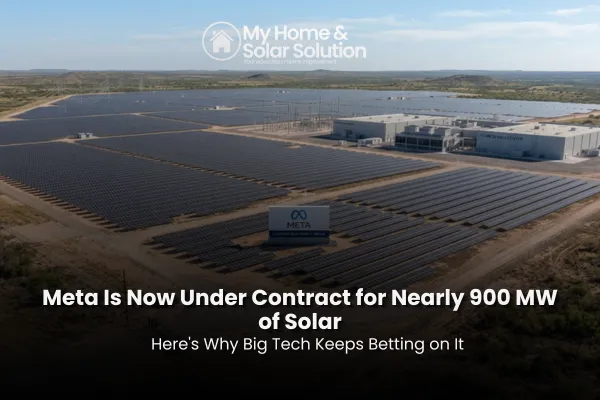
Meta Is Now Under Contract for Nearly 900 MW of Solar. Here's Why Big Tech Keeps Betting on It
Meta Just Signed Its Fourth Solar Deal With RWE in Two Years. Here's Why Big Tech Keeps Betting on Solar
Meta and the German energy company RWE have signed a new long-term power purchase agreement for the 298-megawatt Rabbit's Foot Solar project in Northeast Texas, the fourth solar deal between the two companies in roughly two years.
Rabbit's Foot, currently under construction in Bowie County, is expected to begin commercial operation by the end of 2027. Once online, the electricity it generates will help power Meta's growing data center operations. Combined with three earlier agreements — the 274-MW Emily Solar project in Illinois, the 100-MW Lafitte Solar project in Louisiana, and the 200-MW Waterloo Solar facility in Texas — Meta and RWE now have 872 megawatts of solar capacity under contract over the last two years. The Rabbit's Foot project is also expected to generate more than $50 million in long-term tax revenue over 40 years for Bowie County, the local school district, Texarkana College, and emergency services — money that will help fund schools, road maintenance, and infrastructure in the surrounding community. It's part of a broader pattern: on the same day this deal was announced, a separate developer, Zelestra, revealed Meta had also signed a 180-megawatt solar agreement for a project in Freestone, Texas. Between AI infrastructure buildout and data center expansion, Meta's appetite for solar energy shows no sign of slowing down.
Why Big Tech Keeps Choosing Solar
Meta isn't alone. Amazon, Google, and Microsoft have all signed enormous solar and wind power agreements over the past several years, and for largely the same reasons: predictability and cost control. Solar power purchase agreements let large energy buyers lock in electricity prices for 15, 20, even 30 years — insulating them from the volatility of wholesale power markets and the rising costs of grid infrastructure. For a company running data centers that consume as much electricity as a small city, that predictability is worth billions of dollars over the life of a contract. It's a striking contrast to how residential electricity works. Most homeowners are on the other side of that volatility — their utility bills move with fuel costs, grid maintenance spending, and regulatory decisions they have no control over, with no long-term price lock available to them the way it is for a company like Meta.
What This Means for Homeowners
The math that makes corporate solar deals attractive isn't unique to companies with 900-megawatt appetites. Homeowners who install solar — particularly paired with battery storage — get a version of the same benefit: a way to fix a meaningful share of their energy costs at today's rates instead of riding utility price increases year after year.The scale is obviously different. A homeowner isn't negotiating a multi-decade power purchase agreement with a utility. But the underlying logic — that locking in your own power generation is a hedge against rising and unpredictable electricity costs — is exactly the same reasoning driving Meta, RWE, and every other major solar buyer in the market right now.
My Home & Solar Solution helps homeowners run that same cost-certainty math for their own home: what solar and battery storage would actually save you, and how quickly it pays for itself under your specific utility rate plan. Visit myhomesolution.org to see what the numbers look like for your house.

