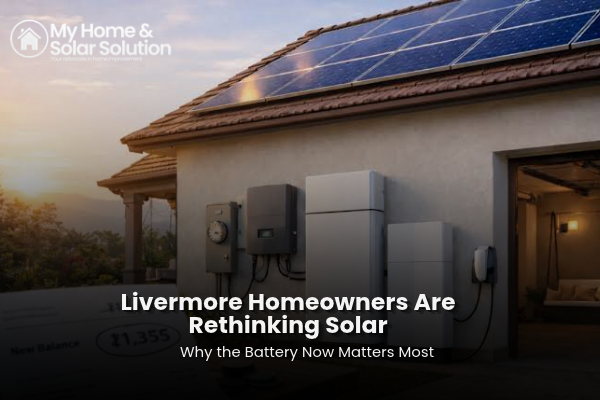
Livermore Homeowners Are Rethinking Solar Why the Battery Now Matters Most
Livermore Homeowners Are Rethinking Solar
Why the Battery Now Matters Most
When the wind picks up over the hills east of Livermore, a lot of Tri-Valley families do the same thing: check their phones for a PG&E shutoff alert and start charging everything in the house. That habit says a lot. In the East Bay, the question homeowners are asking is no longer just "Should I go solar?" It's "What keeps my home running when the grid goes quiet, and how do I get the most out of every kilowatt-hour I make?" Here's what's driving that shift, and why a home battery has become the part of the system that does the heavy lifting.
Shutoffs Are Part of Life Near the Tri-Valley Hills
PG&E uses Public Safety Power Shutoffs (PSPS) to turn off power lines before strong, dry winds can damage them and spark a wildfire. The utility has been clear that these are safety calls. "The reason we call these PSPS events is strictly for safety," a PG&E spokesperson told NBC Bay Area in October 2026. That October event was large. PG&E warned about 70,000 customers across 29 counties that power could be cut, including more than 4,700 customers in Alameda County and more than 1,600 in Contra Costa County, according to NBC Bay Area's October 13-14, 2026 coverage. Livermore has been in the path before. In June 2025, PG&E's shutoff map showed outages near Livermore and Tracy, with about 650 Alameda County customers flagged as possibly affected, ABC7 reported at the time. One Livermore resident who had lived in his home for 56 years told ABC7 that a short outage was manageable, but "if it were more than several hours, then it would be a problem." That's the honest picture. Most shutoffs affect a small slice of customers, and many end within a day or two. But you rarely know ahead of time how long yours will last, and the risk tends to land during hot, dry, windy stretches when you need power the most. You can follow active and upcoming events on our Outage Watch PSPS tracker.
The Bill Side: Rates Have Eased, but Power Is Still Expensive
Here's some good news worth stating plainly: PG&E has lowered residential electric rates several times recently. As of March 1, 2026, PG&E said its residential rates were about 13% lower than in January 2024, its fifth electric rate cut in that span. Even so, power in PG&E territory isn't cheap. PG&E's March 2026 rate advisory put the average residential (non-CARE) rate at about 40.6 cents per kilowatt-hour, with a typical 500 kWh monthly bill of about $203.54 before the California Climate Credit. The way bills are built is changing too. PG&E now includes a Base Services Charge of about $24 a month for most residential customers, which shifts some costs out of the per-kWh price. PG&E says the charge doesn't raise its revenue. Whether your total bill goes up or down depends on how much power you use. For a closer look at what's changing across California utilities this year, see our 2026 California utility bill changes report.
Why Solar Alone Works Differently Than It Used To
If you've heard "NEM 3.0" mentioned at a barbecue, this is what people mean. Since April 15, 2023, new solar customers of California's big investor-owned utilities have joined a Net Billing Tariff adopted by the California Public Utilities Commission (CPUC). PG&E calls its version the Solar Billing Plan. Under the older net metering rules, the solar power you sent to the grid was credited at close to the retail rate. Under the Solar Billing Plan, the credit for exported power is based on CPUC "Avoided Cost Calculator" values, which the CPUC says are usually lower than the price you pay to import power. PG&E says those export credits vary by time of day, day of the week and season. In simple terms, sending your midday solar to the grid earns less than it used to. Using that power yourself, especially in the evening, is where the value is.
Two other details matter here:
Time-of-use pricing. PG&E automatically enrolls Solar Billing Plan customers in its Electric Home rate plan (with some limitations), where peak hours run from 4 to 9 p.m.
An early-adopter bonus. The CPUC says PG&E and SCE residential customers who apply before the end of 2027 get a higher export credit adder for nine years. PG&E describes these as Energy Export Bonus Credits for customers who start on the Solar Billing Plan before 2028. If you already have solar under the old net metering rules, PG&E says those legacy terms generally stay with the system for 20 years, even if the home is sold. Expanding or modifying the system beyond certain limits can move you to the Solar Billing Plan.
Where the Battery Fits In
Picture a typical sunny day in Livermore. Your panels produce the most power around midday, when your household may not need much of it. Then the sun sets, the family comes home, the AC and the oven turn on, and peak pricing starts at 4 p.m. A home battery bridges that gap. It stores the solar energy your home doesn't use at midday, then powers your home during the expensive evening hours instead of sending that energy to the grid for a smaller credit. The CPUC itself notes that customers can get more out of their systems by "installing battery storage along with their generation." The same battery can also keep essentials running during a PSPS event or another outage. How much it can cover, and for how long, depends on the battery's size, how your home is wired, and what you choose to power. A well-planned system usually backs up the essentials, like the refrigerator, lights, internet, phone charging and medical devices, rather than every appliance at full blast. That's why the conversation in the Tri-Valley has moved from "solar or no solar" to "solar plus storage, sized right for my home."
What This Means for Your Household
Here are a few practical questions to work through before you decide anything:
-When do you use the most power? If your use spikes between 4 and 9 p.m., stored solar is worth more to you than exported solar.
-What would you need running during a shutoff? Make a short list. It will shape the size and setup of a battery. Are you on legacy net metering or the Solar Billing Plan? Your bill and your PG&E account will show your plan, and it changes the math. How long do you plan to stay? Upfront ownership costs pay off over years, so your timeline matters.
A Different Way to Get Solar and a Battery
Buying a full solar-plus-battery system outright is a big upfront cost for many families. My Home & Solar Solution is a California-based company that helps qualifying homeowners get solar and battery storage without buying, leasing, or financing equipment. It works through a power purchase agreement (PPA): you pay for the power the system produces, not for the equipment. Qualifying homeowners may save up to 40% on their electricity costs, depending on their usage and their current bill. Qualifying homeowners can also take part in Virtual Power Plant (VPP) events, where the home battery helps support the grid and the homeowner earns compensation on extra energy sold back. To qualify, you need to own your home, use more than 10 kWh per day, and have space for the battery. You can learn more about how solar and battery storage work together, or read what neighbors say in our customer reviews. The next windy evening in the Tri-Valley doesn't have to mean a scramble for flashlights and a worry about the evening peak.
Text "schedule" to 805.870.8415 for a complimentary advisor call to see if your utility bill qualifies.
NBC Bay Area, coverage of PG&E's October 2026 high-wind Public Safety Power Shutoff, published Oct. 13, 2026, updated Oct. 14, 2026. https://www.nbcbayarea.com/news/local/pge-power-shutoff-psps-october-2026-high-winds/4157597/
PG&E, Electric Rate Advisory, effective March 1, 2026 (Advice Letter 7846-E, filed Feb. 27, 2026). https://www.pge.com/assets/pge/docs/account/rate-plans/electric-rate-advisory-0326.pdf
Contra Costa News (PG&E announcement), "PG&E lowers electric prices in March, fifth electric rate drop since early 2024," March 2, 2026. https://contracosta.news/2026/03/02/pge-lowers-electric-prices-in-march-fifth-electric-rate-drop-since-early-2024/
California Public Utilities Commission, "Net Energy Metering and Net Billing," accessed Nov. 9, 2026. https://webtraining.cpuc.ca.gov/industries-and-topics/electrical-energy/demand-side-management/customer-generation/net-energy-metering-and-net-billing

