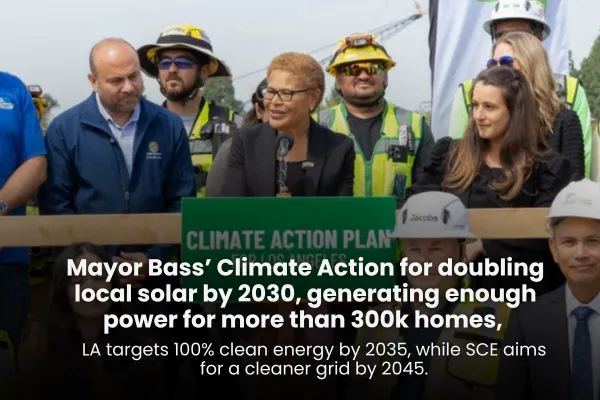
Mayor Bass’ Climate Action Plan calls for doubling local solar by 2030, generating enough power for more than 300,000 homes, LA targets 100% clean energy by 2035, while SCE aims for a cleaner grid by 2045.
Mayor Bass' Climate Action Plan Calls for Doubling Local Solar by 2030, Generating Enough Power for More Than 300,000 Homes
LA Targets 100% Clean Energy by 2035, While SCE Aims for a Cleaner Grid by 2045
Los Angeles is not waiting for Washington to act on energy. Under Mayor Karen Bass, the city has committed to one of the most aggressive local clean energy timelines in the country — and for California homeowners, that ambition creates real, near-term opportunity. Here's what the plan calls for, what it means for you, and how to position yourself ahead of the transition.
The Bass Climate Action Plan: What's Actually in It?
Mayor Bass' LA Climate Action Plan sets out a clear target: double the amount of solar energy generated within Los Angeles by 2030. That would be enough electricity to power more than 300,000 homes — a significant step toward the city's broader goal of achieving 100% clean energy by 2035.
The plan includes:
- Accelerated deployment of rooftop and community solar across Los Angeles
- Expansion of battery storage to reduce dependence on fossil fuel peaker plants
- Investments in energy efficiency and building electrification
- Workforce development programs to support the clean energy transition
- A commitment to ensuring low-income communities are not left behind
This isn't an aspirational white paper. It's a policy roadmap with funding mechanisms, regulatory coordination with the Los Angeles Department of Water and Power (LADWP), and alignment with state-level mandates from the California Public Utilities Commission (CPUC).
Where SCE Fits In
Southern California Edison — which serves much of Ventura County, the San Gabriel Valley, Orange County, and surrounding regions — has set its own milestone: a significantly cleaner grid by 2045, with major milestones along the way including aggressive renewable procurement targets through 2030.
SCE's Pathway 2045 plan involves retiring fossil fuel generation, increasing storage capacity, and expanding distributed energy resources (DERs) — which includes rooftop solar and home battery systems. In practical terms, that means SCE is actively building the infrastructure to support more homes generating and storing their own clean energy. For homeowners on the SCE grid, this matters. As the utility shifts toward a cleaner generation mix, the value of solar paired with battery storage only increases. The grid is getting cleaner — but it's also getting more expensive for those without distributed generation.
Why This Matters for California Homeowners Right Now
Let's be direct: the clean energy transition doesn't lower your bill automatically. In fact, for most California homeowners, utility rates have increased every year for the past decade — and they're projected to continue rising through 2026 and beyond. The homeowners who benefit from the clean energy transition are the ones who act before the transition happens to them. That means going solar and adding battery storage now, while program incentives and net billing structures still exist to support early adopters.
Consider the math. If your electric bill is $200/month today — which is increasingly common in Southern California — you're spending $2,400 a year just to keep the lights on. Over 10 years, that's $24,000 or more, assuming rates don't increase (they will). A solar-plus-battery system that cuts your bill by 60–80% doesn't just save money. It hedges against future rate increases, provides backup power during outages, and adds measurable value to your home.
The LADWP vs. SCE Difference
It's worth noting that LADWP and SCE operate under different rate structures and incentive programs. Homeowners in the city of Los Angeles are typically served by LADWP, while much of Ventura County, the Inland Empire, and surrounding areas are served by SCE.
Both utilities are moving toward cleaner energy, but the incentive programs, net billing rates, and available subsidies differ significantly. If you're in SCE territory, the CPUC's net billing rules (NEM 3.0) apply — and the right solar-plus-battery configuration can still yield substantial monthly savings, particularly for households using most of their electricity in the evening.
The 2030 Window Is Smaller Than It Looks
Doubling local solar by 2030 sounds like a long runway. It isn't. It's four years away. And utility programs, state incentives, and CPUC-approved net billing structures change frequently. Homeowners who lock in systems now benefit from current program terms for the life of their installation — often 25 years or more. The homeowners who wait until 2028 or 2029 may find themselves competing for limited installer capacity, facing different incentive structures, and paying higher baseline rates in the meantime.
GivePower and the Global Dimension
Clean energy isn't just a California story. My Home & Solar Solutions is a proud partner of GivePower, a nonprofit that deploys solar energy and clean water technology in communities across Africa, Asia, and Latin America where grid power is unavailable or unreliable. When you go solar in Southern California, you're joining a global movement — one that recognizes clean, affordable energy as a basic human right, not a luxury. The same technology that powers your home at night using stored solar energy is powering clinics, schools, and water pumps in places that have never had reliable electricity. It's a reminder that the transition to clean energy isn't just about reducing your bill. It's about building the kind of energy system that works for everyone.
What You Can Do Today
If you own a home in California and your electric bill is over $150/month, you likely qualify for a solar-plus-battery program that can significantly reduce your monthly costs — in many cases without purchasing or leasing any equipment. My Home & Solar Solutions works with Ventura County homeowners and surrounding communities to navigate the available programs, identify eligibility, and help families make the transition to clean, reliable energy.
Visit www.myhomesolution.org to learn more or schedule a free consultation. The city of Los Angeles has made its commitment to clean energy by 2035. The question is: will your home be part of it?

