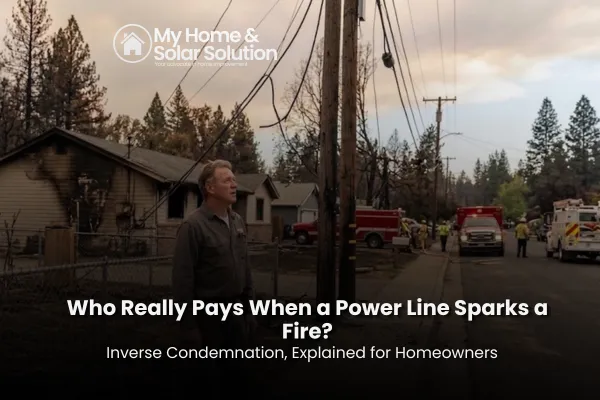
Who Really Pays When a Power Line Sparks a Fire? Inverse Condemnation, Explained for Homeowners
Who Really Pays When a Power Line Sparks a Fire? Inverse Condemnation, Explained for Homeowners
When a wildfire starts because of a utility power line, most people assume the utility is responsible only if it was negligent — if it failed to maintain equipment properly or ignored a known hazard. Under California's inverse condemnation doctrine, that's not actually the standard. A utility can be held financially liable for wildfire damage caused by its equipment even if it did everything by the book, simply because the equipment was involved.
Where this legal doctrine actually comes from
Inverse condemnation originated as a constitutional principle requiring compensation when government action damages private property, and California courts have extended it to investor-owned utilities acting in a quasi-governmental capacity, given their status as regulated monopolies providing an essential public service. The practical effect is a strict liability standard: if utility equipment is a substantial cause of a fire, the utility can be held liable for the resulting damages, regardless of fault.
Why this ends up on every customer's bill, not just the utility's shareholders
Utilities facing this kind of liability typically pursue several paths to cover the cost: insurance (increasingly expensive and hard to obtain at the scale utilities need), self-insurance funds built up over time, securitized recovery bonds that spread costs over many years, and rate increases approved through the regulatory process. In practice, a meaningful share of wildfire liability costs ultimately gets passed through to ratepayers rather than absorbed entirely by utility shareholders, since regulators generally allow utilities to recover a substantial portion of these costs through rates as a legitimate cost of providing service.
Why this creates such strong incentive for aggressive wildfire prevention
Because inverse condemnation liability doesn't require proving negligence, utilities face financial exposure from essentially any fire connected to their equipment, which is part of why California utilities have leaned so heavily into Public Safety Power Shutoffs and grid hardening investments, both are direct responses to a liability structure that makes prevention cheaper than the alternative, even when prevention means shutting off power to hundreds of thousands of customers.
What this means for homeowners trying to understand their bill
Every dollar of wildfire liability a utility faces under inverse condemnation eventually shows up somewhere on a customer's bill, whether through direct rate increases, recovery bond charges, or self-insurance fund contributions costs that have nothing to do with an individual household's own electricity usage. If you want to understand how wildfire liability costs are affecting your bill, and how reducing grid dependence through solar and battery storage could help, My Home & Solar Solutions can walk you through it. Visit myhomesolution.org to learn more.

