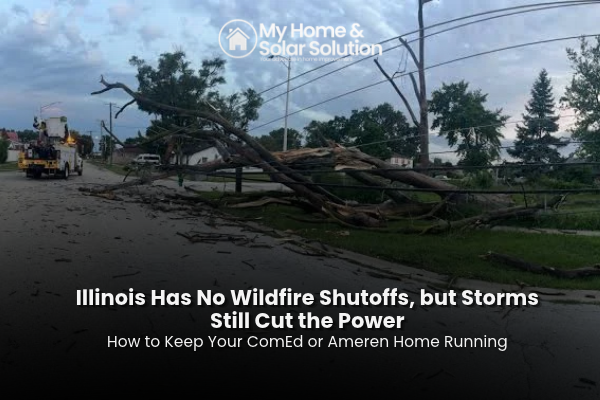
Illinois Has No Wildfire Shutoffs, but Storms Still Cut the Power How to Keep Your Comed or Ameren Home Running
Illinois Has No Wildfire Shutoffs, but Storms Still Cut the Power
How to Keep Your ComEd or Ameren Home Running
Illinois utilities do not turn off power on purpose to prevent wildfires. The bigger risk for most homeowners here is severe weather knocking out power without warning.
If you live in ComEd or Ameren Illinois territory, that is the outage story worth planning around.
What the 2026 storm season looked like
The Chicago Sun-Times reported that storms this year knocked out power to 2.4 million homes in ComEd territory. Most outages lasted an hour or less, but some south suburban residents were without power for up to five days.
ComEd says its goal is to restore power within 12 to 24 hours after the most severe storms, but it acknowledges that extreme damage can make that hard (ComEd's stated goal). Downstate, Ameren Illinois reported a storm with winds up to 70 mph on August 13 that peaked at about 26,000 customers without power. The next morning, about 18,000 were still out, nearly all in the Bloomington-Normal area, where Ameren said damage was significant.
Why a few hours can turn into days
When a storm brings down trees and poles, crews have to inspect, clear and repair line by line. That can mean the last customers on a street wait the longest. ComEd says its smart grid upgrades helped avoid about 2.7 million outages this year, and that without them the count would have been more than double (ComEd's claim). That helps with short interruptions. It does not stop a tree from taking down a line to your house.
What a home battery changes
A battery paired with solar can keep key circuits running when the grid goes down, such as the refrigerator, lights, internet and phone chargers. During a multi-day outage, solar can recharge the battery the next day if the system is set up for backup. The common worry is cost. Many homeowners assume storage means a large purchase.
How third-party ownership (TPO) works
In a TPO program, a company installs, owns and maintains the solar and battery system at your home. You pay for the power it produces without buying, leasing, or financing equipment. Many programs are designed to come in below utility rates, with savings of up to 40% depending on your home and program.
Here is what a TPO solar and battery program can offer:
Backup power for essential circuits during storm outages
Stored solar energy for evening hours when you use the most power
Equipment maintenance handled by the system owner for the term
Availability, savings and backup design depend on your home, your utility and the program.
To find out if your home qualifies for a TPO solar and battery program, visit myhomesolution.org
Additional resources
Chicago Sun-Times, ComEd customers pay billions to keep the lights on during storms: https://chicago.suntimes.com/environment/2026/09/02/chicago-comed-power-grid-outage-storms-electric-bills-weather-gary-indiana-climate-change
Ameren Illinois Storm Communications Update, Aug. 14, 2026: https://ameren.mediaroom.com/2026-08-14-Ameren-Illinois-Storm-Communications-Update

