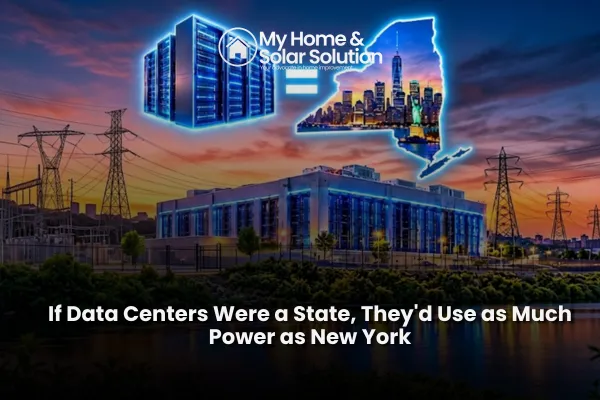
If Data Centers Were a State, They'd Use as Much Power as New York
If Data Centers Were a State, They'd Use as Much Power as New York
Imagine California's data center pipeline as its own state. How would it rank among the 50? Based on the power developers are requesting, it would sit right alongside New York and Illinois, two of the largest economies in the country.
The comparison
According to the U.S. Energy Information Administration, New York used about 140 billion kilowatt-hours of electricity in 2024, and Illinois used about 133 billion. North Carolina used about 137 billion. Data center developers have asked PG&E for about 15,000 megawatts of power. Running at full power year-round, that would be about 131 billion kilowatt-hours a year, in the same range as those states. It is more than Michigan, Arizona or Washington use in a year.
Requests versus signed deals
Many of these requests are early-stage or speculative and will not all be built. But signed agreements on PG&E's system reached about 4,000 megawatts by the end of 2025, roughly 35 billion kilowatt-hours a year at full power, or about half of New Jersey's annual use.
What a state-sized load means
Adding demand on the scale of a large state requires new transmission lines, substations and generation. The California Energy Commission projects statewide electricity use could rise more than 50 percent by 2045. Consumer advocates have warned that ratepayers could be left paying for upgrades if data center projects fall short.
And unlike a state full of homes, data centers do not slow down at night. They keep running through the evening hours, when electricity is most expensive.
What it means for homeowners
California electricity already averages about 30 cents per kilowatt-hour. When the grid has to grow to serve a state-sized load, homeowners who depend entirely on it have little protection from rising costs. As AI drives demand higher, every home will be on one side of the meter. Homes that only buy from the grid pay for its growth. Homes with solar and batteries produce their own power, store it for the evening, and send extra electricity back to the grid for compensation. Some homeowners may dislike supplying a grid that serves data centers. But it is better than being on the other side of the meter, buying from a grid that just added a New York. Qualifying homeowners can get solar and battery storage through third-party ownership programs without buying or financing equipment. And with SB 913, California is developing a method to value battery power sent to the grid during high demand.
The takeaway
If data centers were a state, they would rank among the biggest energy users in America. Homeowners can protect themselves with power they produce and store, and savings that can reach up to 40 percent compared with utility rates, depending on the home and program.
To find out if your home qualifies for a TPO solar and battery program, visit myhomesolution.org/california_public_utility_commissions

