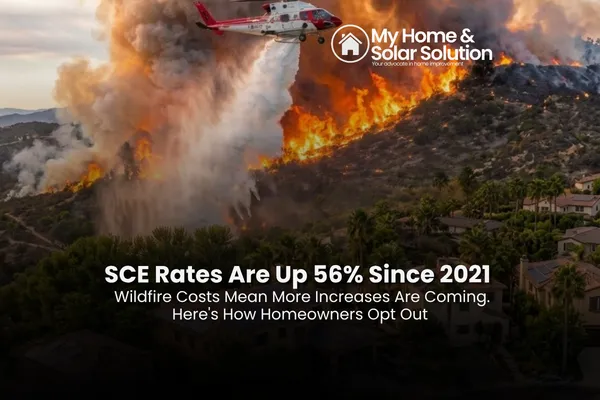
SCE Rates Are Up 56% Since 2021 Wildfire Costs Mean More Increases Are Coming. Here's How Homeowners Opt Out
SCE Rates Are Up 56% Since 2021
Wildfire Costs Mean More Increases Are Coming. Here's How Homeowners Opt Out
If you are a Southern California Edison customer, you have probably noticed your bill climbing for years. The numbers confirm it. According to the CPUC's Public Advocates Office, SCE's average residential rate rose from roughly 22 cents per kilowatt-hour in January 2021 to about 34.4 cents in June 2026, an increase of 56 percent in about five years. Over 10 years, SCE's average residential rate is up 101 percent.
Wildfire costs are a big part of the story
The Public Advocates Office identifies wildfire mitigation and wildfire liability as major drivers of rising rates statewide. As of January 2026, wildfire-related costs made up about 14 percent of SCE's revenue requirement, the money the utility collects from customers.
Some of those costs come from fires linked to utility equipment. In January 2025, the CPUC voted 4 to 0 to allow SCE to recover $1.6 billion from customers for costs related to the 2017 Thomas Fire, spread over 30 years. SCE said most residential customers would pay about $1 more per month as a result. SCE has also requested approval to recover an additional $5.4 billion in costs related to the 2018 Woolsey Fire. And SCE continues to face costs connected to the January 2025 Eaton Fire, which could add further pressure in the years ahead.
The rules for setting rates are changing too
On September 3, 2026, the CPUC opened a new rulemaking to overhaul how general rate cases work, the process utilities use to request rate increases. It is the first major revision of the framework since 2007, aimed at improving transparency and possibly linking utility compensation to performance. Analysts caution that changing the process can only do so much for affordability, and California still has the second-highest electricity rates in the nation. SCE has said its 2026 rates are lower than at the end of 2025 and that future increases are projected to track at or below inflation on average through 2030. Still, wildfire costs, grid investments, and new legal obligations mean the long-term pressure on rates is not going away.
How homeowners opt out of the cycle
You cannot control wildfire settlements or rate cases. You can control how much electricity you buy from the utility. Homeowners who produce and store their own power reduce their exposure to every future increase. A rooftop solar system generates electricity during the day, and a battery stores it for the evening hours when SCE's time-of-use prices are highest. Together, they cut the amount of grid power your home needs. The battery also keeps essential loads running during outages, including public safety power shutoffs, a common reality in high fire-risk areas of SCE's territory.
No purchase required
Through third-party ownership programs, qualifying homeowners can get solar and battery storage installed without buying or financing equipment. The provider owns and maintains the system, and the homeowner pays for the energy or service, often at a rate designed to come in below current utility rates. Depending on the home and program, savings can reach up to 40 percent compared with utility rates. SCE customers have absorbed a 56 percent increase in five years. If you would rather produce your own power than pay for the next round of increases, see if your home qualifies.
To find out if your home qualifies for a TPO solar and battery program, visit myhomesolution.org/california_public_utility_commissions

