Whole-House Battery or Critical Loads Only? How to Figure Out Exactly How Much Backup Your California Home Needs
Whole-House Battery or Critical Loads Only? How to Figure Out Exactly How Much Backup Your California Home Needs
When California homeowners start shopping for battery backup, one of the first questions they encounter is one most installers don't explain clearly: do you want whole-home backup or critical loads only? The answer changes everything — the number of batteries you need, the cost, the complexity of installation, and how your home actually behaves during an outage. Getting this decision right before you sign anything is essential.
Here's a plain-language breakdown of both options, how to assess your own needs, and how to think about what "enough backup" actually means for your household.
What Is a Critical Loads Panel?
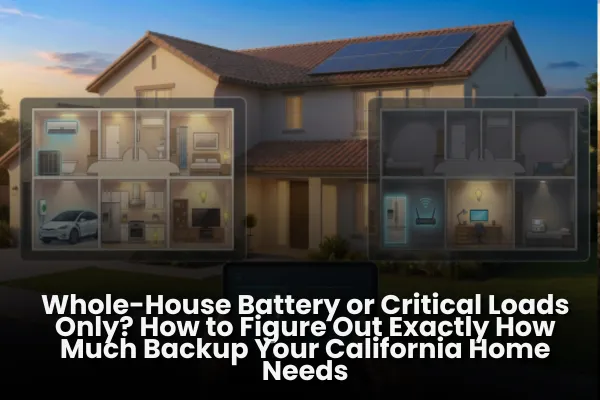
A critical loads panel is a separate electrical subpanel that's wired to receive backup power from your battery during an outage. Only the circuits connected to this subpanel stay powered when the grid goes down. Everything else — circuits wired directly to your main panel — goes dark.
Typical critical loads include:
- Refrigerator and freezer
- Lighting in key rooms
- Phone and internet equipment (router, modem)
- Medical devices
- One or two outlets in the main living area
- Garage door opener (if specifically wired in)
What's typically NOT included in a critical loads configuration: central HVAC, electric vehicle charger, electric range/oven, clothes washer and dryer, hot tub, or workshop circuits. These are high-draw appliances that would drain a single battery in hours. A critical loads setup is a practical choice for homeowners who want basic protection — food preservation, communication, basic lighting — during outages that typically last 12–24 hours. It's also the most cost-effective starting point for battery backup.
What Is Whole-Home Backup?
Whole-home backup means your battery system can power every circuit in your home, not just a selected subset. When the grid goes down, your home operates essentially normally — lights, appliances, HVAC, and all.
The catch: whole-home backup requires significantly more battery capacity. A typical 2,000 square foot California home with air conditioning, a refrigerator, and normal lighting might draw 4–6 kW during active use. A single 13.5 kWh Tesla Powerwall 3 can sustain that load for roughly 2–3 hours of normal operation — or much longer if you moderate your usage.
True whole-home backup through an extended outage typically requires two to four batteries, depending on home size, climate, and how conservatively you're willing to use energy during the event. In Southern California, where summer outages often coincide with heat waves that make air conditioning a health necessity rather than a comfort, whole-home backup is a serious consideration for many families.
How to Assess Your Own Backup Needs?
Start with three questions:
1. How long do outages typically last in your area?
If you're in an area prone to PSPS events — Ventura County, foothill communities, rural or semi-rural areas adjacent to fire zones — outages can stretch 24–72 hours. Critical loads backup may be adequate for a 12-hour event but inadequate for a 3-day event. Check your address against SCE's PSPS risk maps to understand your specific exposure.
2. Does anyone in your household have a medical or health need that depends on power?
CPAP machines, home oxygen concentrators, insulin that requires refrigeration, motorized mobility equipment — any of these shifts the calculus toward more robust backup. A single Powerwall running critical loads can keep a CPAP running for 2–3 nights depending on the model and use pattern, but medical dependencies warrant a specific conversation with your installer about load calculations.
3. How do you use your home during the day?
Remote workers who depend on internet, video calls, and computers all day have different backup needs than homeowners who are out of the house during the day and only need overnight protection. If your grid outages tend to happen during high-demand summer afternoons when you're home and the AC is running, your peak backup draw is much higher than if outages typically happen overnight when most circuits are idle.
The Solar Factor: Why Panels Change the Equation
Here's what changes the backup math significantly: if your battery system is paired with solar panels, the battery can recharge during the day even while the grid is down. A 10 kW solar array on a typical Southern California day generates 40–60 kWh of energy. If your battery depletes overnight and the sun comes up, you're back to a full charge before noon. For homeowners with solar plus two or more batteries, multi-day outages become entirely manageable — not a crisis, just a different way of operating for a few days.
This is why sizing matters. A battery system that seems inadequate in isolation — one Powerwall for a whole-home setup — becomes very capable when paired with adequate solar generation. The panels replenish what the battery depletes, extending your effective backup window almost indefinitely.
The Sizing Conversation You Need to Have
The right battery configuration for your home isn't determined by a brochure. It requires a load analysis — a review of your actual electricity consumption patterns, your peak draw appliances, your typical outage duration risk, and your backup priorities. My Home & Solar Solutions conducts this analysis as part of our consultation process for Ventura County homeowners and the broader Southern California market. We don't recommend a standard package. We recommend what's right for your home, your family, and your risk profile.
For qualifying homeowners, we also have access to TPO programs that allow you to get solar and battery backup installed at no upfront cost — with monthly payments typically well below what you're currently paying the utility.
Visit https://myhomesolution.org/california_public_utility_commissions to start the conversation. Knowing how much backup you need is the first step toward having it when it matters.

