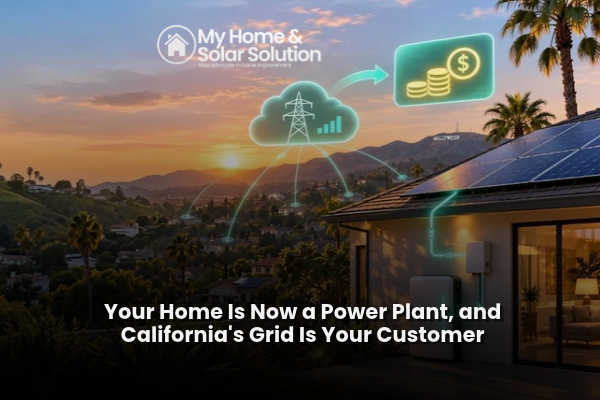
Your Home Is Now a Power Plant, and California's Grid Is Your Customer
Your Home Is Now a Power Plant, and California's Grid Is Your Customer
California homeowners are entering a new era of energy production. Instead of simply buying electricity from their utility, homeowners with solar and battery storage can now help supply power to the grid and potentially earn money for doing so.
On October 6, 2026, residential home batteries delivered a record 745 megawatts (MW) of electricity to California's grid during a heat wave. According to one participating company, that was enough to power every household in San Francisco and San Jose combined during peak hours.
The message is clear: homes are becoming an important part of California's energy infrastructure.
California Homes Are Becoming Energy Producers
Solar adoption and battery storage are growing rapidly across California. PG&E has surpassed one million customer solar connections, while the California Energy Commission reports more than 21,000 MW of battery resources supporting the state's grid. Home batteries are especially valuable during evening hours, when solar production declines but electricity demand remains high.Through Virtual Power Plants (VPPs), thousands of connected home batteries can work together, sending stored electricity to the grid when utilities need it most. Participating homeowners may receive compensation while maintaining a reserve for their own household.
How Homeowners Can Earn From Their Energy
California's Net-Billing program allows eligible solar customers to receive credits for electricity exported to the grid. However, export values vary throughout the day.
For Southern California Edison customers, average 2026 summer export credits are approximately:
Daytime: $0.06 per kWh
Evening: $0.21 per kWh
Overnight: $0.12 per kWh
This is why battery storage matters. Instead of sending inexpensive midday solar energy to the grid, homeowners can store it and use or export it during higher-value evening hours. Additional opportunities come through programs such as the Demand Side Grid Support (DSGS) program and Emergency Load Reduction Program (ELRP), which compensate eligible battery owners for supporting the grid during periods of high demand. Program availability and payments can change, particularly as California's 2027 DSGS funding remains uncertain.
California Is Giving Home Batteries a Bigger Role
On September 30, 2026, Governor Newsom signed SB 913 and SB 905, two bills designed to improve how California uses its energy resources. SB 913 establishes a pathway for home batteries and other distributed energy resources to count toward utility electricity supply requirements. SB 905 encourages utilities to make better use of existing grid infrastructure and explore ways to reduce unnecessary energy-system costs. Together, these laws recognize that residential batteries can become valuable grid resources rather than simply backup equipment.
What This Means for Your Electricity Bill
For homeowners, the benefits go beyond selling electricity. Lower energy costs: Store solar energy and use it during expensive evening hours instead of purchasing as much electricity from the utility. Backup power: Keep essential household appliances operating during outages and Public Safety Power Shutoffs (PSPS). Potential additional income: Participate in qualifying grid programs that compensate homeowners for sharing stored electricity. Greater energy independence: Generate, store, and manage more of your household's electricity instead of relying entirely on utility power.
With SCE's average residential rate reaching approximately 34.5 cents per kWh in October 2026, having greater control over when and how you use electricity can make a meaningful difference. Eligible homeowners may save up to 40% on utility costs, depending on their usage and program terms.
Become an Energy Producer With MHSS
My Home & Solar Solution (MHSS) helps qualifying California homeowners access solar and battery storage without purchasing, leasing, or financing the equipment upfront.
Through a Power Purchase Agreement (PPA), homeowners pay for the electricity their system produces while potentially benefiting from lower energy costs and participating in available Virtual Power Plant opportunities. To qualify, homeowners generally need to own their home, use more than 10 kWh of electricity daily, and have adequate space for battery installation.
Your Home Can Do More Than Consume Electricity
California's energy landscape is changing. Homeowners with solar and battery storage have an opportunity to lower electricity expenses, maintain backup power, and potentially earn compensation by supporting the grid. Instead of being only an electricity customer, your home could become part of the solution.
Want to find out if your home qualifies?
Text "SCHEDULE" to 805.870.8415 for a complimentary advisor call and discover your MHSS solar and battery options.

