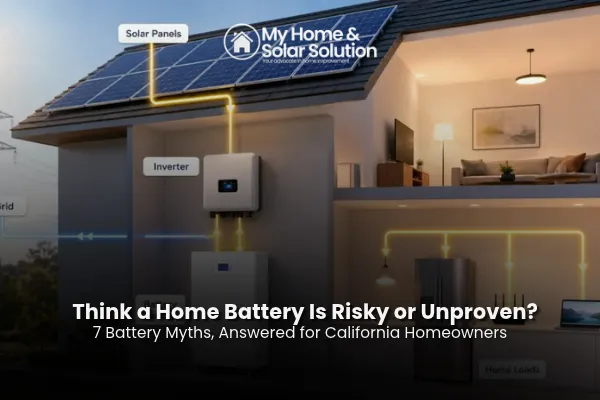
Think a Home Battery Is Risky or Unproven? 7 Battery Myths, Answered for California Homeowners
Think a Home Battery Is Risky or Unproven?
7 Battery Myths, Answered for California Homeowners
Batteries are in the news more than ever, and so are the rumors about them. If you have wondered whether storage is new, risky or only for people who own it, you are not alone.
Southern California Edison recently went through the most common misconceptions. Here is what they mean for your home.
Myth 1: Batteries only work with solar
Batteries can also store grid power when supply is plentiful and release it when demand is high. Solar makes them more useful at home, but it is not the only way they work.
Myth 2: Battery storage is new and experimental
It is an established technology. SCE's Tehachapi project began operating in 2014 and was one of the first large-scale systems in North America.
Myth 3: Battery sites are left unattended
They are not staffed full time, but SCE says they are remotely operated and monitored around the clock, with crews sent when maintenance is needed.
Myth 4: Battery sites and data centers are the same thing
They can look alike from the outside. Data centers house computers. Battery facilities store electricity for the grid.
Myth 5: Batteries are built mainly for data centers
SCE says they support the whole grid. Data centers are one piece of rising demand, and SCE projects electricity demand will double by 2045.
Myth 6: Battery storage is unsafe
SCE says its facilities are engineered, built, tested and operated under extensive engineering and emergency-response requirements. For your own home, the same principle applies. Ask any installer about the equipment, certifications and inspections involved.
Myth 7: Only people who own batteries benefit
Customer batteries provide backup power. Grid-scale batteries help whole communities at peak. SCE's battery portfolio can power about 6.6 million homes for four hours, and the company says storage helped it avoid Flex Alerts and rotating outages during a September heat wave.
What this means for your home
If the main thing holding you back is the sense that batteries are unproven, the record says otherwise. The harder question is how to get one without a big upfront check.
How third-party ownership (TPO) works
In a TPO program, a company installs, owns and maintains the solar and battery system at your home. You pay for the power it produces without buying, leasing, or financing equipment. Many programs are designed to come in below utility rates, with savings of up to 40% depending on your home and program.
Here is what a TPO solar and battery program can offer:
-Backup power during outages
-Stored solar for expensive evening hours
-Maintenance covered for the term
Curious what that looks like for your roof? Check your options here. To find out if your home qualifies for a TPO solar and battery program, visit myhomesolution.org
SCE Energized, 7 Myths About Battery Storage: https://energized.edison.com/stories/7-myths-about-battery-storage

