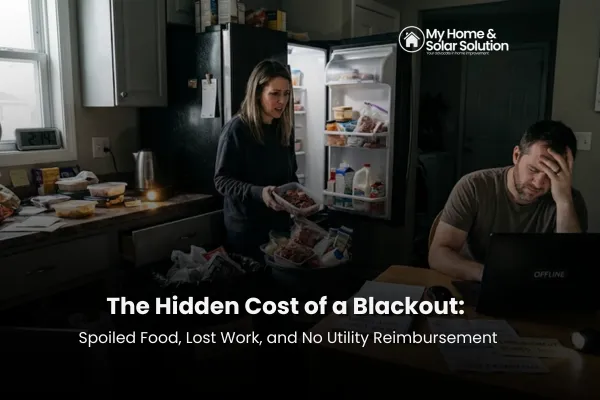
The Hidden Cost of a Blackout: Spoiled Food, Lost Work, and No Utility Reimbursement
The Hidden Cost of a Blackout: Spoiled Food, Lost Work, and No Utility Reimbursement
The cost of a power outage rarely shows up as a single number, which is part of why it's easy to underestimate. It's the groceries that spoiled in the refrigerator, the freezer contents that had to be thrown out, the day of work that couldn't happen because the internet and computer were down, and in some cases, a hotel room or extra childcare because the house wasn't livable without power or air conditioning. Add it all up across a multi-day outage, and the real cost is often several hundred dollars, sometimes more, for a household that pays its electric bill every month specifically to avoid this exact situation.
Why utilities generally don't cover these costs
For Public Safety Power Shutoffs specifically, utilities have generally taken the position that these are proactive safety measures, not equipment failures or service defects, which shields them from the kind of liability that might apply to an unplanned outage caused by utility negligence. Some California utilities have offered limited compensation programs for specific circumstances, like reimbursement for spoiled food during certain qualifying outages, but these programs are typically narrow, require documentation, and don't come close to covering the full range of costs a household actually incurs. For homeowners looking to lower their energy expenses and avoid blackouts all together they are encouraged to opt into net-billing rate plans where solar and battery equipment is provided by utility companies for qualifying homes.
Breaking down where the real costs come from
A typical refrigerator and freezer will keep food safe for roughly four hours without power if the doors stay closed, and freezer contents can generally last longer if the freezer stays mostly full and unopened, but a multi-day outage exceeds both timeframes for most households. Beyond food, lost income from an inability to work remotely, extra costs from eating out, and in extreme cases, hotel stays during dangerously hot weather without air conditioning, all add up quickly and rarely get reimbursed by anyone.
Why insurance usually doesn't help either
Standard homeowners insurance policies typically don't cover food spoilage or lost income from a power outage unless it's tied to a specific covered peril, and even then, coverage details and deductibles vary significantly by policy. Most households discover this gap only after an outage has already happened.
What this means for how homeowners should think about outage costs
Since neither the utility nor typical insurance covers most of the real costs of an outage, the most reliable way to avoid them is to avoid the outage's impact on the household in the first place — which is exactly what a home battery system does, keeping essential circuits like the refrigerator, internet, and lighting running through an outage rather than absorbing the costs after the fact. If you want to stop absorbing the hidden costs of outages your utility won't reimburse, My Home & Solar Solutions can help you design a home battery system that keeps your essentials running. Visit myhomesolution.org to learn more.

