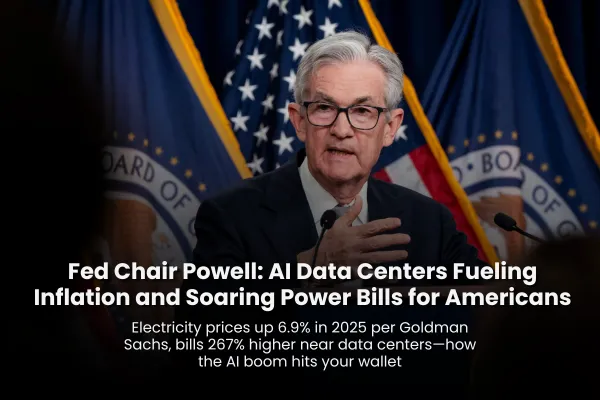
Fed Chair Powell: AI Data Centers Fueling Inflation and Soaring Power Bills for Americans
Electricity prices up 6.9% in 2025 per Goldman Sachs, bills 267% higher near data centers—how the AI boom hits your wallet
Federal Reserve Chair Jerome Powell has now put the AI data center boom inside the inflation debate. At his March 2026 press conference, Powell said the U.S. is “building data centers everywhere,” adding that the construction surge is putting pressure on “goods and services” and is “probably pushing inflation up.”
The issue is simple: AI requires massive computing power, and that computing power requires electricity, land, cooling, transmission lines, transformers, labor, and new generation. Powell’s warning was not that AI will never improve productivity. It was that the near-term buildout is hitting the economy before those productivity gains reach households.
Goldman Sachs says the pain is already showing up in utility bills. Electricity prices rose 6.9% year over year in 2025, more than double the 2.9% headline inflation rate. Goldman expects consumer electricity prices to rise another 6% through 2027 before slowing to 3% in 2028.
That matters because higher power costs do not stop at the electric meter. Goldman warned that hospitals, restaurants, manufacturers, and retailers may pass rising utility expenses into everyday prices, adding pressure to core inflation.
Bloomberg’s findings show why the issue is becoming political. Its 2025 analysis found that wholesale electricity costs were as much as 267% higher than five years earlier in areas near major data center activity, with those costs increasingly passed through to customers.
The impact is spreading beyond one or two technology hubs. CBS News reported that data center growth is driving up utility bills in at least 13 states, citing the Institute for Energy Economics and Financial Analysis. The same report highlighted the Bloomberg finding that Americans living near data centers may be paying as much as 267% more per month for energy than five years ago.
Georgia is becoming a national test case. Georgia Power has proposed a $15 billion plan to expand electricity capacity by 50% over six years, with data centers expected to use 80% of the new power.Critics worry that if utilities build too much infrastructure for speculative data center demand, residential customers could be left paying for power plants, pipelines, and grid upgrades.
The pressure may continue through 2030. Goldman Sachs Research forecasts global data center power demand will rise 50% by 2027 and as much as 165% by 2030 compared with 2023 levels.
For American households, the AI boom may first show up not as cheaper services, but as higher electric bills, higher prices, and tougher monthly budgets.
For businesses and homeowners, the takeaway is clear: waiting for utility rates to stabilize may not be enough. Many are now going solar without leasing, financing, or buying solar panels and batteries upfront by using Power Purchase Agreement programs and Virtual Power Plant programs.
Instead of owning the equipment or leasing it, customers can go directly to the source of local solar and storage power, pay for the energy they use, and reduce dependence on rising utility rates. In many cases, these programs can cut electric bills by up to 50%, giving families and companies a practical way to protect their budgets as AI-driven power demand puts more pressure on the grid.

