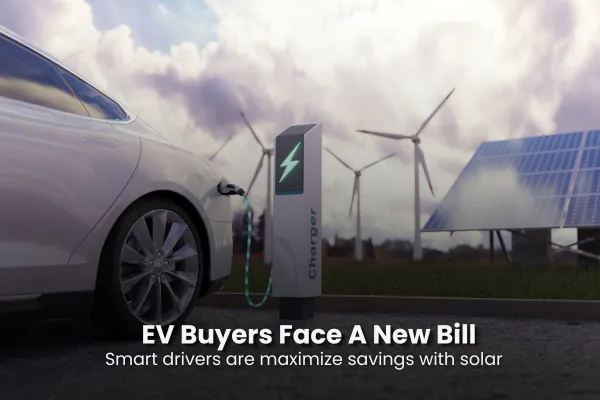
EV Buyers Face A New Bill Smart drivers are maximize savings with solar
EV Buyers Face A New Bill
Smart drivers are maximizing their savings with solar.
Buying an electric vehicle used to feel like a decision about the future.
In 2026, it's become a very practical decision about today — and for a growing number of drivers, a used EV is the most affordable way in.
But here's what the window sticker doesn't tell you.
The moment you drive an EV home, your electricity bill becomes part of your transportation budget.
And in California, that matters more than almost anywhere else in the country.
Used EV sales are surging as drivers look for cheaper transportation. The appeal is obvious — for families spending hundreds of dollars a month on gasoline, switching to electric promises real savings.
And the savings can be real. Charging an EV at home is dramatically cheaper than gasoline for the same number of miles. One analysis found that covering roughly 1,000 miles a month at home could cost around $60 in electricity, compared to nearly $150 in gasoline for a typical gas vehicle.
But there's a catch that catches a lot of new EV owners off guard.
Public fast charging can cost more than gasoline. And charging at home during the wrong hours can quietly erase much of the savings.
In California, "the wrong hours" are specific. Under SCE's time-of-use rate plans, charging an EV between 4 and 9 PM on a summer weekday — when peak rates climb sharply — turns that cheap home charging into something far less attractive. The same miles, charged at the wrong time, can cost two to three times more.
The drivers who are actually capturing the full savings of EV ownership are the ones paying attention to when and how they charge.
There's a bigger shift happening too. When an EV enters a household, transportation costs that used to leave at the gas station now flow entirely through the electric meter. A typical EV adds 200 to 400 kilowatt-hours per month to a home's electricity use.
And your EV isn't the only thing adding demand to the grid.
AI data centers are driving electricity demand at a scale the grid was never built for. Reporting has linked data centers to a significant share of recent U.S. electricity demand growth — and that demand puts upward pressure on utility rates for everyone.
So the household energy math in 2026 looks like this:
* Your EV adds hundreds of kilowatt-hours per month
* Summer air conditioning drives peak-hour demand
* Your utility is raising rates to fund grid modernization and wildfire hardening
* AI data center demand is accelerating the need for new capacity
* All of it meets at your meter
The homeowners who understand this picture are making different decisions about how their homes are powered.
The EV owners who are genuinely winning on cost aren't just charging off-peak. Many are generating their own electricity during the day and storing it — including for overnight EV charging — so they regain control over the cost of powering their homes and vehicles
Here's how it works. Solar panels generate power during the day. A battery stores it. In the evening, when peak rates hit, the home draws from the battery instead of the grid. The EV charges overnight at the lowest-cost window — or directly from stored solar.
For EV owners, a solar-plus-battery system can:
* Dramatically reduce the cost of charging at home
* Avoid expensive peak-hour grid imports
* Provide backup power during outages
* Offset the higher monthly electric bill an EV creates
* Protect against future rate increases driven by AI and grid demand
For many EV households, a properly sized system can offset a meaningful portion of the added charging cost — sometimes more than offsetting it entirely.
And the upfront cost no longer has to be a barrier.
Qualifying homeowners served by SCE, SDG&E, or PG&E may be able to access TPO solar and battery programs with no lease, loans or cash payments required for equipment, install or maintenance.
You made a smart decision buying an EV. The next smart decision is making sure the electricity powering it is just as affordable as you expected.
To find out if your home qualifies for a TPO solar and battery program, visit https://myhomesolution.org/california_public_utility_commissions
Additional resources:
[CNBC: EV Ownership Costs](https://www.cnbc.com/2026/05/03/ev-ownership-costs.html)
[CPUC Net Billing Information](https://www.cpuc.ca.gov/industries-and-topics/electrical-energy/demand-side-management/customer-generation/net-energy-metering-and-net-billing)
[My Home & Solar Solution News](https://news.myhomesolution.org/news)
[Learn More About Solar + Battery Programs](https://myhomesolution.org/home-7068)

