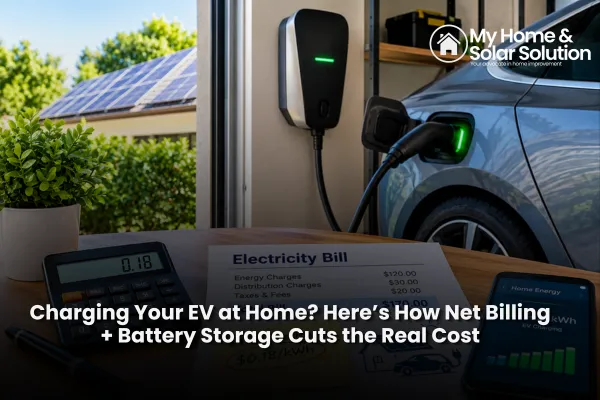
Charging Your EV at Home? Here’s How Net Billing + Battery Storage Cuts the Real Cost
Charging Your EV at Home? Here's How Net Billing + Battery Storage Cuts the Real Cost
Home charging is already the cheapest way to power an EV, but the way California's net billing rules work can make a big difference in how much of that cost a homeowner with solar actually pays. Under net billing, which replaced the older net metering framework, homeowners get credited for the solar power they export to the grid at rates tied to the wholesale value of electricity at that moment — typically much lower than the retail rate they pay to import power back. That mismatch matters a lot for EV owners.
Why exporting solar and importing power for charging doesn't pencil out under net billing
A homeowner without a battery who charges an EV in the evening is essentially selling their midday solar export for a low net billing credit, then buying grid power back at a much higher retail rate to charge the car later. Under the old net metering rules, that trade was close to a wash; under net billing, it's a real net cost, because the export credit and the import price are no longer roughly equal.
How a battery closes the gap
A home battery lets a homeowner skip that mismatched trade entirely. Instead of exporting midday solar for a low credit and buying it back later at a high rate, the battery stores that solar power directly and discharges it when the EV needs to charge — whether that's overnight or during peak hours. The homeowner uses their own power at close to zero marginal cost instead of participating in a net billing exchange that now favors the utility.
What this means for EV charging costs specifically
EV charging is one of the largest single new loads a solar household can add, and it's also one of the most flexible in terms of timing. That flexibility is exactly what makes it a strong match for a battery: instead of needing to charge during whatever hours are cheapest on the grid, a battery-equipped home can charge from stored solar nearly any time, sidestepping both peak utility rates and the low net billing export credit.
The bottom line for homeowners with an EV and solar, or considering both
Under today's net billing rules, pairing a battery with solar isn't just about backup power — it directly changes the math on EV charging costs, turning a mismatched export-then-import trade into a much more favorable use of the solar you're already generating.
If you have an EV, or you're considering one, and want to understand how net billing and battery storage affect your actual charging costs, My Home & Solar Solution can walk you through the numbers. Visit myhomesolution.org to learn more.

