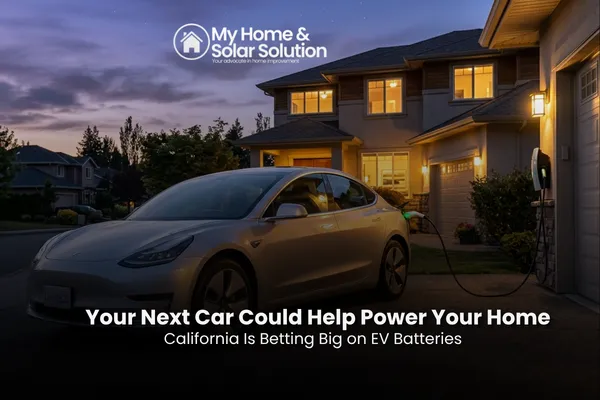
Your Next Car Could Help Power Your Home California Is Betting Big on EV Batteries
Your Next Car Could Help Power Your Home
California Is Betting Big on EV Batteries
The batteries parked in California driveways could soon become one of the state's largest sources of energy storage. A new report from GridLab, Kevala, and E3, titled Unlocking California's Flexible Load, looks at how electric vehicles and other home energy devices could help address rising electricity rates and grid reliability.
What the study found
California expects about 9.7 million light-duty electric vehicles on the road by 2036. Together, those vehicles would represent more than 110 gigawatts of battery capacity, far more than the roughly 31 gigawatts of utility-scale storage the state has planned. The report found that enrolling just 10 percent of those EVs in vehicle-to-grid programs could deliver about one-third of California's energy storage goals by 2036, assuming programs are designed so these vehicles can perform like grid-scale storage. GridLab Executive Director Ric O'Connell summed it up this way: the next generation of grid infrastructure is already sitting in our driveways, homes, and businesses.The authors recommend that future programs pay for verified performance, align compensation with the actual value to the grid, and move forward alongside retail rate reform.
Home energy storage is becoming the norm
The bigger message is that California's energy future depends on storage located at homes, not just at power plants. Whether that storage sits in a garage-mounted battery or in the car parked next to it, homes that can store and use their own energy are becoming central to how the grid works. Utilities are already moving in this direction. PG&E has expanded its vehicle-to-everything program, allowing compatible EVs to provide backup power to homes and send energy back to the grid, and the state has recorded record dispatches from home battery fleets during heat waves.
Why solar and a home battery come first
For homeowners on SCE, SDG&E, and PG&E, vehicle-to-home technology is promising, but it is still early. Bidirectional charging requires compatible vehicles and chargers, and an EV that is away from home during the day or at work during an outage cannot power the house. A stationary home battery paired with rooftop solar is available today and works every day. Solar panels produce power during the day, the battery stores it, and your home uses that energy in the evening when time-of-use rates peak. When the grid goes down, the battery keeps essential loads running. And when you do add an EV, charging it from your own solar can cut fueling costs even further. Think of solar and storage as the foundation. It sets your home up for today's savings and tomorrow's technology, including vehicle-to-home systems as they mature.
Start without buying the equipment
Through third-party ownership programs, qualifying homeowners can get solar and battery storage installed without buying or financing equipment, while enjoying lower energy costs and backup power. California is betting that homes will power the grid of the future. If you want your home ready for that future, and saving money now, it is worth seeing if you qualify.
To find out if your home qualifies for a TPO solar and battery program, visit myhomesolution.org/california_public_utility_commissions

