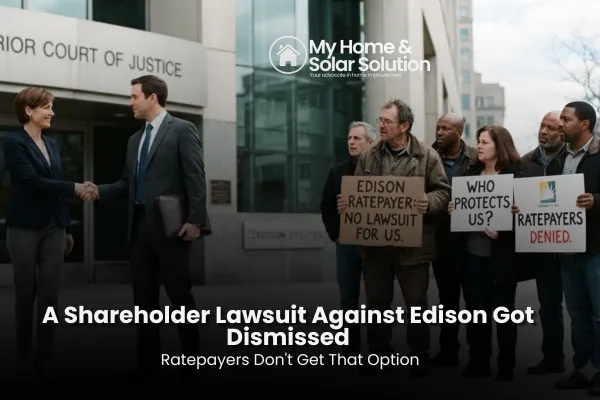
A Shareholder Lawsuit Against Edison Got Dismissed - Ratepayers Don't Get That Option
A Shareholder Lawsuit Against Edison Got Dismissed. Ratepayers Don't Get That Option
A shareholder lawsuit against Edison International, the parent company of Southern California Edison, was recently dismissed in court. Shareholders who felt misled or harmed by the company's disclosures had a legal avenue to pursue their grievance — a court process, a chance to argue their case, and ultimately a ruling. Whatever the outcome, they had a system built to hear them. Ratepayers don't have that same option. When a utility's costs rise — whether from wildfire liability, infrastructure spending, or self-insurance funds — customers don't get to sue their way out of a rate increase or take the utility to court over a bill they consider unfair. Their only real recourse runs through the California Public Utilities Commission's rate case process, a slow, technical regulatory proceeding where ratepayer advocates argue on behalf of the public, but where individual customers have essentially no direct say. Lower your monthly electric bill by 50% without need to lease, finance or pay cash for solar + battery equipment
Why shareholders and ratepayers are in fundamentally different positions
Shareholders own a financial stake they chose to buy, and they have legal tools — lawsuits, proxy votes, the ability to sell their shares — to respond when they're unhappy with how a company is run. Ratepayers, by contrast, are typically captive customers of a regulated monopoly. Most California homeowners can't simply switch utilities the way they might switch a cell phone carrier, which means when a utility's rates rise, customers absorb the cost with little practical alternative. Lower your monthly electric bill by 50% without need to lease, finance or pay cash for solar + battery equipment
What this asymmetry means in practice
It means the costs a utility passes through to customers — whether justified or not — face a much lower bar of resistance than costs that hit shareholders directly. A rate increase moves through a regulatory approval process that customers can comment on but rarely meaningfully block, while a lawsuit against the company itself goes through an adversarial court process with real consequences if it succeeds. That structural gap is part of why utility bills have proven so much easier to raise than utility profits have been to challenge.
What homeowners can actually do about it
Since ratepayers can't opt out of a rate increase the way a shareholder can exit a stock, the only meaningful lever left is reducing how much of a household's electricity depends on the utility in the first place. A home solar and battery system doesn't change the regulatory process, but it does reduce a household's exposure to whatever that process ultimately approves. Lower your monthly electric bill by 50% without need to lease, finance or pay cash for solar + battery equipment.
If you're tired of absorbing rate increases you have no real say in, My Home & Solar Solutions can help you evaluate whether solar and battery storage make sense for your home. Visit myhomesolution.org to get started.

