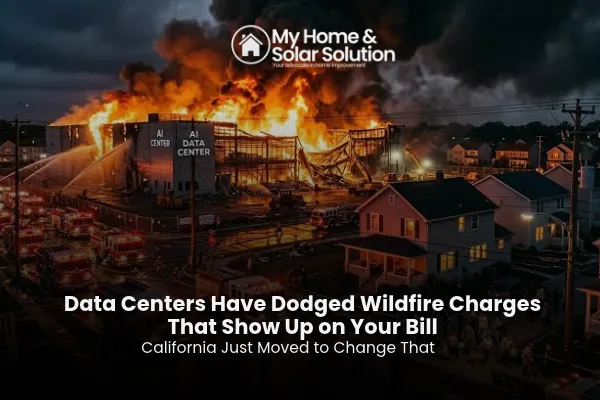
Data Centers Have Dodged Wildfire Charges That Show Up on Your Bill California Just Moved to Change That
Data Centers Have Dodged Wildfire Charges That Show Up on Your Bill
California Just Moved to Change That
If you pay an SCE, SDG&E or PG&E bill, part of it covers wildfire prevention and liability. That cost is spread across the customers who use the local wiring. Some of the biggest new power users have been able to connect higher up the system. That raised a fair question: are homeowners carrying costs that data centers avoid?
What changed in September
When Governor Newsom signed the data center package on September 21, 2026, one bill targeted this gap directly. AB 2383 requires data centers to pay tariffs covering wildfire mitigation, wildfire liability and other societal costs usually collected from distribution-level customers, according to law firm Mayer Brown. It focuses on data centers that connect at the transmission level, where they could otherwise sidestep those distribution charges.
State Senator Steve Padilla, who authored a related bill, said data centers would also pay for their own transmission upgrades and generation, and carry a larger share of wildfire mitigation and liability costs, KPBS reported.
What it means for your bill
These laws aim to keep new data center costs from being shifted onto existing customers. They do not lower the charges already on your bill. The new generation tariffs for community choice providers are due by January 1, 2028, and the CPUC has until then on the broader tariff work. Until then, you still pay what your current rate plan says.
The part you can control
Wildfire costs also show up in a way no law can fix: shutoffs and outages. If the grid goes down, a rate change on paper does not keep your fridge running. Solar with a battery gives you a second source of power at home. It cuts the amount you pull from the grid, and it can keep key circuits on during an outage.
How third-party ownership (TPO) works
In a TPO program, a company installs, owns and maintains the system on your roof. You pay for the power it produces without buying, leasing, or financing equipment. Many programs are designed to come in below utility rates, with savings of up to 40% depending on your home and program.
Before you sign anything, see what a TPO solar and battery program could cover:
Backup power when the grid goes down.
Maintenance handled for the length of the agreement.
Clear terms if you sell or refinance your home.
A quick qualification check takes the guesswork out of it.
To find out if your home qualifies for a TPO solar and battery program, visit myhomesolution.org
Additional resources
KPBS, State senator says new data center laws will protect consumers, Sept. 21, 2026: kpbs.org
Mayer Brown, California's Governor Signs Nation's Most Comprehensive Data Center Laws, Sept. 28, 2026: mayerbrown.com

