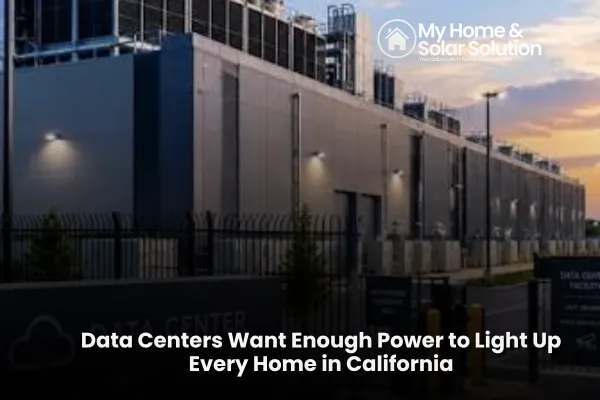
Data Centers Want Enough Power to Light Up Every Home in California
Data Centers Want Enough Power to Light Up Every Home in California
California's power grid is facing a request unlike anything homeowners have seen before. By December 2025, data center developers had asked PG&E for roughly 15,000 megawatts of electricity, according to figures released by the California Energy Commission. That is up from about 12,000 megawatts just three months earlier. To put that number in perspective, 15,000 megawatts running around the clock for a year adds up to about 131 billion kilowatt-hours. If the average California home uses about 8,000 kilowatt-hours a year, that is enough electricity for roughly 16.4 million homes. California has about 15.06 million homes in total, according to the state Department of Finance. In other words, data centers are asking for more electricity than every home in the state uses.
Not every request will be built, but the signed deals are real
It is important to be clear about what these numbers mean. Many of these are requests, and some are speculative projects that may never break ground. But the projects with signed agreements nearly doubled in the same period, from about 2,000 megawatts to about 4,000 megawatts. That alone is enough electricity for roughly 4.4 million homes. Southern California Edison has its own queue of nearly 5,000 megawatts of data center requests. And the California Energy Commission now forecasts that statewide electricity use could rise by more than 50 percent by 2045.
Why this matters for your electric bill
Every new large customer on the grid needs new power lines, new substations and new generation to keep the lights on. Those upgrades cost billions of dollars, and the Public Advocates Office has warned that if data center projects fall through or fail to bring in the revenue utilities expect, everyday customers could be left paying for the infrastructure. Utilities argue that more large customers can spread fixed costs and help lower rates. Homeowners have heard promises like that before. What they have seen in practice is that California electricity is already among the most expensive in the country, averaging about 30 cents per kilowatt-hour, second only to Hawaii.
Two sides of the meter
As artificial intelligence drives up demand, every California home is going to end up on one side of the meter or the other. On one side are homes that buy every kilowatt-hour from the grid at whatever price the utility sets. On the other side are homes that produce their own power, store it in a battery, and send extra energy back to the grid for compensation. Some homeowners do not love the idea of helping supply a grid that is feeding data centers. But the alternative is competing with those data centers for the same electricity and paying the price when demand spikes.
How homeowners are moving to the supply side
The good news is that homeowners no longer need to pay cash or take out a loan to make that move. Through third-party ownership programs, qualifying California homeowners can get solar and battery storage installed without buying or financing equipment. The system powers the home first, the battery covers the expensive evening hours, and extra energy sent to the grid earns bill credits. California is also starting to recognize the value of home batteries. Governor Newsom signed SB 913, which directs the California Public Utilities Commission to set a value for home batteries that send power to the grid during high demand. That opens the door for battery owners to be compensated for the power their systems provide when the grid needs it most.
The bottom line
Data centers are planning for decades of power. Homeowners can do the same. Producing and storing your own electricity means less exposure to rising rates, backup power when the grid is strained, and savings that can reach up to 40 percent compared with utility rates, depending on the home and program.
To find out if your home qualifies for a TPO solar and battery program, visit myhomesolution.org/california_public_utility_commissions

