Data Centers Want Nearly a Third of California's Record Peak Power
Data Centers Want Nearly a Third of California's Record Peak Power
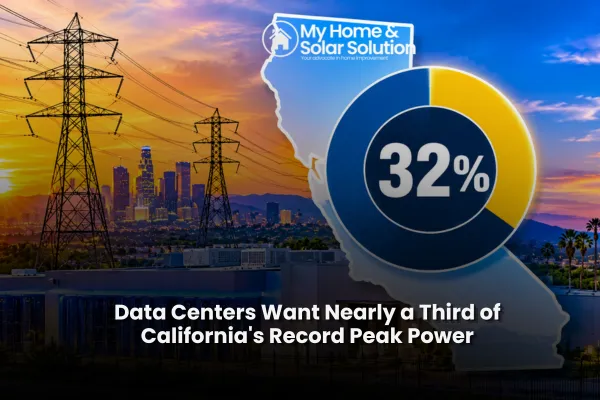
On a sweltering day in September 2022, California set an all-time record for electricity demand: 52,061 megawatts. That is the most power the state's grid has ever had to deliver at one moment. It came during a severe heat wave, when air conditioners across the state were running at full blast. Now consider this: data center developers have asked PG&E for about 15,000 megawatts of power. That is about 29 percent of California's record peak, nearly a third.
Why peak demand matters most
The grid does not struggle all day. It struggles during the hottest late afternoons and evenings, roughly 4 to 9 p.m., when solar production fades and demand stays high. Those are the hours when the grid is closest to its limits and when electricity is most expensive for SCE, SDG&E and PG&E customers on time-of-use plans. Homes use less power late at night. Data centers do not. They run around the clock, often at about 80 percent of their capacity or more, including through the evening peak.
Requests versus reality
Not all of the 15,000 megawatts in requests will be built. Many are early-stage or speculative. But signed agreements reached about 4,000 megawatts by the end of 2025, and Southern California Edison has nearly 5,000 megawatts of data center requests of its own. Even a portion of that demand, added during peak hours, puts more pressure on the most expensive part of the day.
What it means for your bill
When peak demand grows, utilities need more generation, storage and transmission to meet it. Those costs tend to show up in rates over time. California electricity already averages about 30 cents per kilowatt-hour, second only to Hawaii.
The battery advantage
This is exactly where home batteries shine. A home with solar and a battery stores its midday solar production and uses it during the evening peak instead of buying grid power at the highest prices. When the home has extra energy, it can send power back to the grid and earn credits. California's SB 913 directs regulators to set a value for battery power sent to the grid during high demand, recognizing the role home batteries play at peak.
Choosing your side of the meter
Homes that only buy from the grid pay peak prices. Homes that produce and store their own power can supply the grid when it needs help most. Some homeowners may not love supplying a grid that serves data centers, but it is better than buying from it at peak prices.
Qualifying homeowners can get solar and battery storage through third-party ownership programs without buying or financing equipment.
The takeaway
Data centers want nearly a third of California's record peak. Homeowners can protect themselves during those peak hours with stored solar power and savings that can reach up to 40 percent compared with utility rates, depending on the home and program.
To find out if your home qualifies for a TPO solar and battery program, visit myhomesolution.org/california_public_utility_commissions

