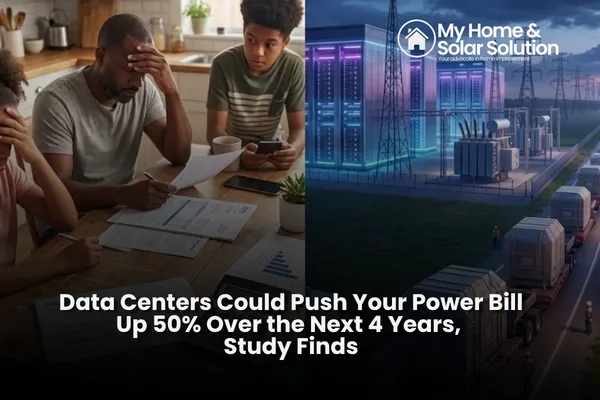
Data Centers Could Push Your Power Bill Up 50% Over the Next 4 Years, Study Finds
Data Centers Could Push Your Power Bill Up 50% Over the Next 4 Years, Study Finds
A new study is warning that electricity costs in some states could rise more than 50% over the next four years, driven largely by the explosive growth of AI data centers. These massive facilities run around the clock and consume as much electricity as a small city, and utilities across the country are scrambling to build new generation and transmission capacity to keep up with demand that's growing faster than the grid can expand. The catch for ordinary homeowners: those costs don't stay with the data centers. Utilities recover the cost of new power plants, transmission lines, and grid upgrades by raising rates across their entire customer base, meaning households that use a fraction of a data center's electricity end up subsidizing infrastructure built primarily to serve tech companies.
Why this is a bigger deal than a typical rate increase
Historically, rate increases tracked inflation and routine maintenance. What's happening now is different in scale: some utilities are proposing to spend tens of billions of dollars on new generation capacity specifically to serve data center demand, and regulators in several states are approving multi-year rate increases to fund it. A 50% increase over four years isn't a rounding error on a monthly bill — for many households, it's hundreds of dollars a year in additional cost for infrastructure they didn't ask for and don't benefit from directly.
How homeowners can protect themselves from a bill they don't control
Homeowners can't stop a utility from signing up new data center customers or from raising rates to fund the infrastructure that follows. What they can control is how much of their own electricity comes from the grid in the first place. A home solar and battery system generates and stores power independent of whatever rate increases utilities approve to serve industrial customers, effectively insulating a household's electricity costs from a trend that has nothing to do with how that household actually uses power.
The math only gets more favorable over time
If data center demand keeps climbing the way current forecasts suggest, the gap between grid electricity prices and the fixed cost of a home solar system is likely to widen, not shrink. Locking in solar and battery costs now, before the next round of data-center-driven rate hikes takes effect, is increasingly the more predictable path for homeowners who want some control over their own energy costs. If rising electricity rates driven by data center demand have you rethinking your power bill, My Home & Solar Solution can help you explore whether solar and battery storage make sense for your home. Visit myhomesolution.org to get started.

