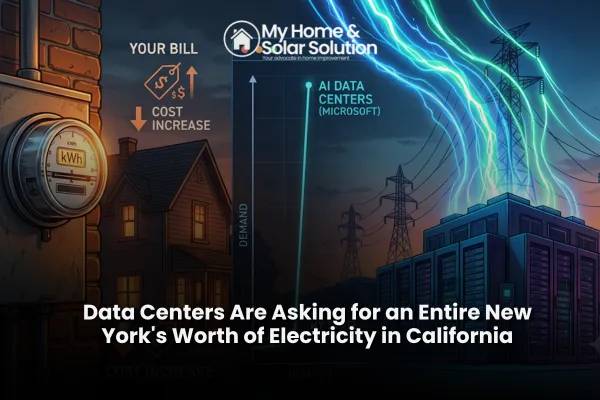
Data Centers Are Asking for an Entire New York's Worth of Electricity in California
Data Centers Are Asking for an Entire New York's Worth of Electricity in California
Picture the entire state of New York: every home, office tower, subway line and factory. In 2024, New York used about 140 billion kilowatt-hours of electricity, according to the U.S. Energy Information Administration. Now picture California being asked to supply almost that much new electricity, just for data centers. That is roughly what data center developers are asking for.
The numbers behind the comparison
By December 2025, data center developers had requested about 15,000 megawatts of power from PG&E. If all of that ran at full power year-round, it would use about 131 billion kilowatt-hours a year, close to New York's 140 billion. At 8,000 kilowatt-hours per home, it would be enough for about 16.4 million homes. These are requests, and many may never be built. But signed agreements alone reached about 4,000 megawatts, or about 35 billion kilowatt-hours a year at full power.
Why the comparison matters
California already uses about 246 billion kilowatt-hours a year. Adding a New York-sized load on top would mean building a massive amount of new transmission, substations and generation. Those projects take years and cost billions, and state consumer advocates have warned that ratepayers could end up paying if data center projects fall short. The California Energy Commission projects statewide electricity use could rise more than 50 percent by 2045, with data centers playing a growing role.
What this means for your home
When demand grows faster than supply, the most expensive hours of the day get more expensive. For SCE, SDG&E and PG&E customers on time-of-use plans, those hours already fall in the late afternoon and evening, the same time data centers keep running at full speed.
Choosing your side of the meter
As AI drives up energy demand, every home will be on one side of the meter. Homes that only buy from the grid pay rising prices. Homes with solar and batteries produce their own power, store it for the evening, and send extra electricity back to the grid for compensation. Some homeowners do not like the idea of supplying a grid that serves data centers. But being a supplier is far better than being on the buying side, competing for the same electricity.
Getting on the supply side
Qualifying California homeowners can get solar and battery storage through third-party ownership programs without buying or financing equipment. California's SB 913 directs regulators to set a value for battery power sent to the grid during high demand, opening the door for home battery owners to be compensated.
The takeaway
Data centers are asking California for almost a New York's worth of electricity. Homeowners can protect themselves with power they produce and control, and savings that can reach up to 40 percent compared with utility rates, depending on the home and program.
To find out if your home qualifies for a TPO solar and battery program, visit myhomesolution.org/california_public_utility_commissions

